
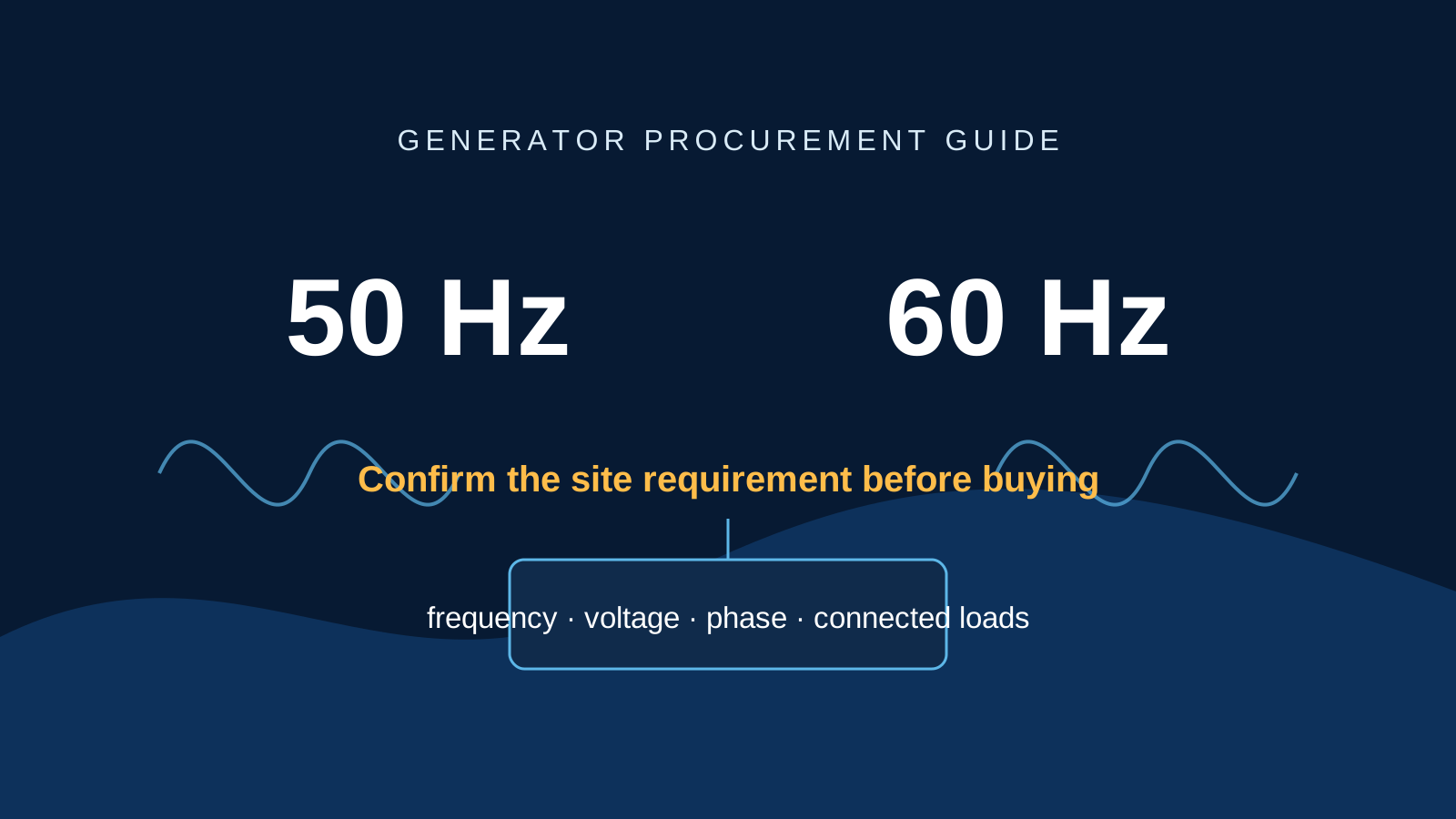
What does the 50 Hz / 60 Hz difference tell you?
The useful purchasing question is which frequency your installation requires. Start there before comparing generator prices or accepting a proposed alternative. The relationship between generator speed and frequency helps explain the equipment specification, but it cannot settle the whole purchase decision.
Cummins' T-030 application manual gives this example for a generator with a four-pole field:
| Item | 50 Hz example | 60 Hz example |
|---|---|---|
| Specified frequency | 50 Hz | 60 Hz |
| Speed in the manual's four-pole example | 1500 rpm | 1800 rpm |
| What the example establishes | Speed for that frequency and pole count | Speed for that frequency and pole count |
| What still needs confirmation | Exact set rating and application suitability | Exact set rating and application suitability |
Keep the four-pole qualification attached to the numbers. This example is not a changeover procedure, a promise of dual-frequency operation or evidence that an offered set keeps the same output rating at both frequencies. Ask the manufacturer to identify the configuration being quoted.
Start with the site electrical specification
Record the required frequency, voltage and phase from the project's electrical specification, with the responsible electrical designer confirming any missing information. A destination country helps identify the project, but it should not replace the site's actual electrical requirements in your RFQ.
Be precise about what the voltage describes. Ask the project team to state the required voltage arrangement and identify the relevant supply and load documentation. If the specification and a connected machine's nameplate disagree, send both records for review instead of selecting whichever value appears more familiar.
Cummins' voltage-selection guidance says the application largely determines generator voltage; in emergency and standby applications, output voltage usually corresponds to the utilization voltage of the loads. Treat voltage and frequency as separate entries that need to agree with the application, rather than deriving one from the other.
For a three-phase installation, include phase-sequence confirmation in the qualified commissioning team's scope. T-030 states that the generator's phase rotation must match the facility's normal power source and be checked before operating the electrical loads. This is a verification responsibility to assign, not a wiring task to improvise from a buying guide.
Check the equipment that will receive the power
Give the supplier a load list with nameplates and manufacturer input requirements, especially for motors, drives, transformers, UPS equipment and separately powered auxiliaries. Record the exact equipment model next to each document so that a broad description such as “pump” or “UPS” does not become the basis for an unqualified compatibility assumption.
If one item is labelled for both 50 Hz and 60 Hz, keep that information attached to that item. It does not establish that the rest of the installation accepts both. Where a label is unclear or the operating conditions differ from the documentation, ask the equipment manufacturer to confirm the permitted application.
Also separate the nominal frequency requirement from allowable frequency changes while loads connect or disconnect. Cummins notes that UPS equipment can be sensitive to voltage dips and frequency excursions, including requirements associated with bypass operation. Ask for the actual UPS input limits and operating-mode requirements; do not invent a universal tolerance for the RFQ.
This review identifies which load documents and limits are needed. Detailed motor-start sizing and transfer-system design remain separate engineering decisions.
Treat a frequency change as a manufacturer review
If a seller proposes changing a 50 Hz set to 60 Hz, or the reverse, ask for a written decision for the exact generator model and configuration. Do not approve the substitution from a generic speed table or an assurance that the controller has a setting for it.
Request confirmation of the resulting electrical output and rating basis, the engine and alternator combination, and any required changes to controls, protection or supplied auxiliaries. Ask which manufacturer documentation covers the proposal and what verification is required. These are questions for the supplier to resolve, not a claim that every component needs changing.
When that evidence is unavailable, leave the proposed conversion unapproved and ask for an offer documented for the required frequency. Neither the four-pole example nor this checklist confirms that a particular GENKVA model is convertible or available in both configurations.
Put these records in the RFQ
The supplier needs a consistent electrical brief before an offer can be assessed against it. Use the following record list to make unknowns visible and give each unresolved item a specific next step.
| Record | What to include | If it is missing or inconsistent |
|---|---|---|
| Site electrical basis | Destination, required Hz, voltage arrangement and phase | Ask the project electrical designer to confirm the requirement. |
| Load evidence | Equipment models, nameplates, input limits and relevant operating modes | Obtain the manufacturer's data; mark unresolved limits as unknown. |
| Requested generator duty | Required output, rating basis and site conditions | Keep assumptions explicit for the supplier's review. |
| Offered configuration | Exact set, engine, alternator, controller and electrical rating | Request the applicable model documentation and a controlled quotation revision. |
| Verification scope | Required drawings, proposed nameplate details and agreed test records | Agree responsibilities and acceptance evidence before approving the order. |
The generator RFQ Builder organizes application, duty, load, voltage, frequency, phase and destination inputs. Use it to assemble what you know, and identify values that still need confirmation. Its purpose is to organize the enquiry; the supporting equipment documents still need to accompany the technical review.
Resolve mismatches before approving the order
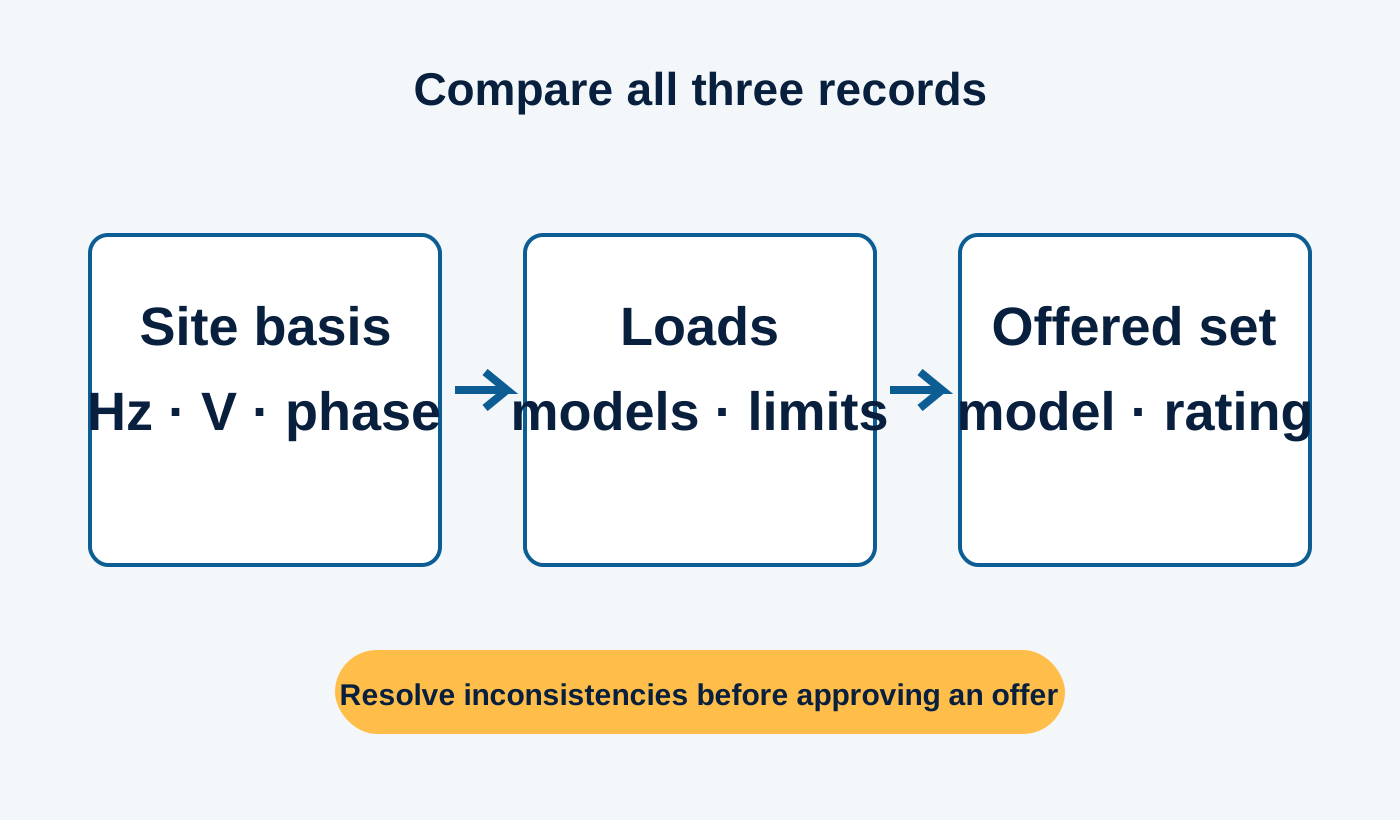
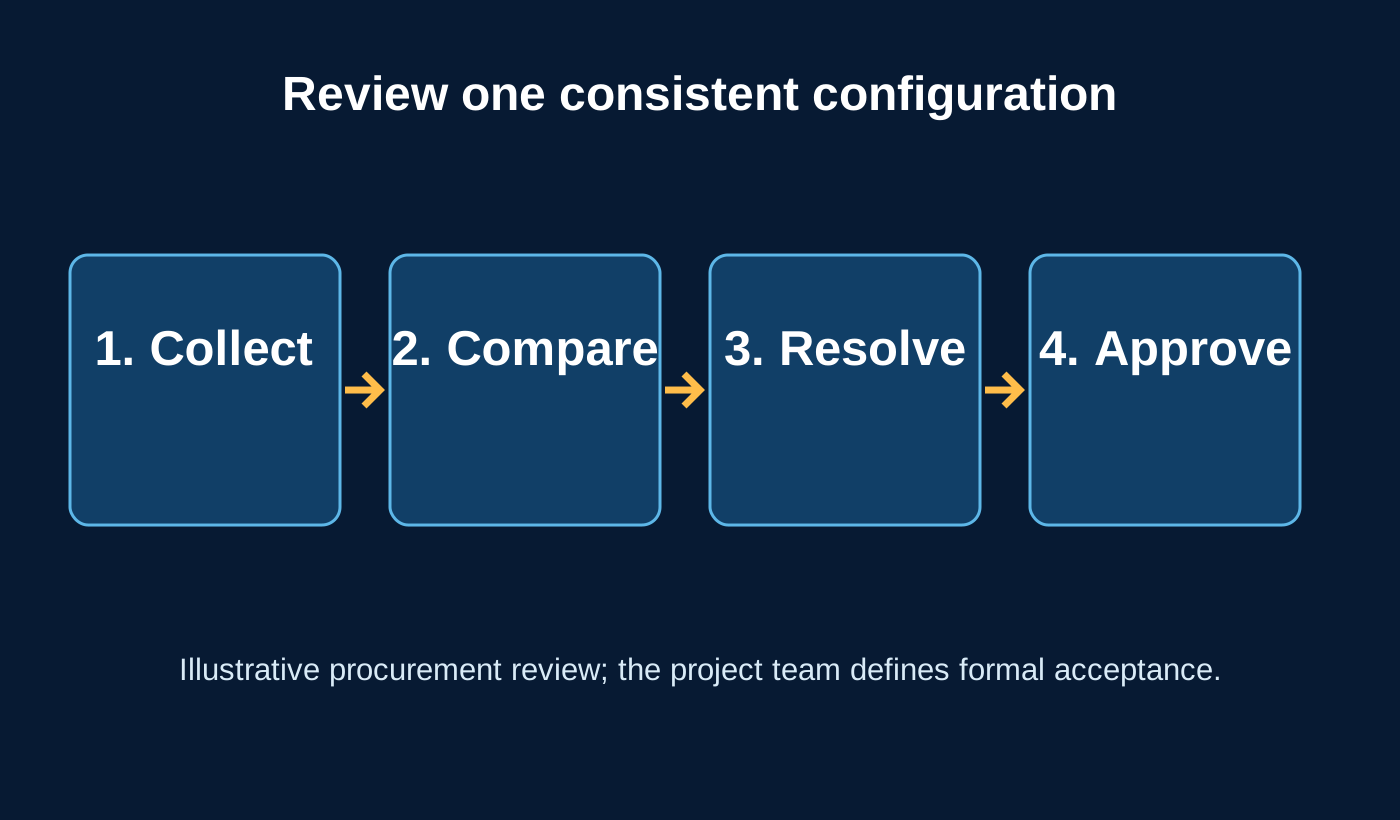
Compare the same frequency, voltage and phase across the quotation, equipment schedule, applicable manufacturer data and proposed nameplate details. Agree which test records will document the supplied configuration and when those records will be reviewed. Ask for a corrected revision when the documents conflict, then confirm that the correction appears throughout the order package.
For an illustrative purchasing check, suppose the site schedule calls for 60 Hz but the offered model sheet describes a 50 Hz configuration. Matching the headline kVA is not enough to close that document mismatch. Ask the supplier to provide the applicable 60 Hz configuration and rating evidence, or revise the offer. Keep the item unresolved until the responsible reviewers accept one consistent set of documents.
Sources and scope
Cummins T-030 Liquid-Cooled Generator Set Application Manual: voltage selection, UPS load considerations, and the glossary entries for phase rotation and poles. The reviewed text carries a February 2015 edition date; the 2024 folder in its download URL is not the edition date. The manual supports the bounded application principles cited here, not GENKVA model availability or permission to convert a particular set.
The record matrix and mismatch example are an editorial procurement framework, not a report of a performed test. Use current documentation for the exact equipment and have the responsible project professionals confirm final suitability.
Engineering review
Prepare a quote with the electrical requirements attached
Have the site frequency, voltage, phase, destination, load list, required output and duty ready when you request a generator quote. Include the supporting documents and label any unknowns. That gives the preliminary review a clear starting point and makes the remaining configuration questions explicit.
Request a generator quote