
When a quotation lists an exhaust pipe and a silencer, the practical procurement question is whether the documents describe the same engine, operating condition and proposed installation. If the silencer changes or the route is revised, ask which data and review records correspond to the new package. A diameter on a drawing cannot answer those questions by itself.
First agree what pressure the documents describe
An engine's whole-system backpressure and the pressure drop across an individual silencer are different entries in the review. The DieselNet exhaust backpressure definition describes engine-outlet backpressure as the gauge pressure imposed by the complete exhaust system; a component's pressure drop describes the loss across that component. Its readable definition preview is useful for this distinction, not as a source of a limit for your engine.
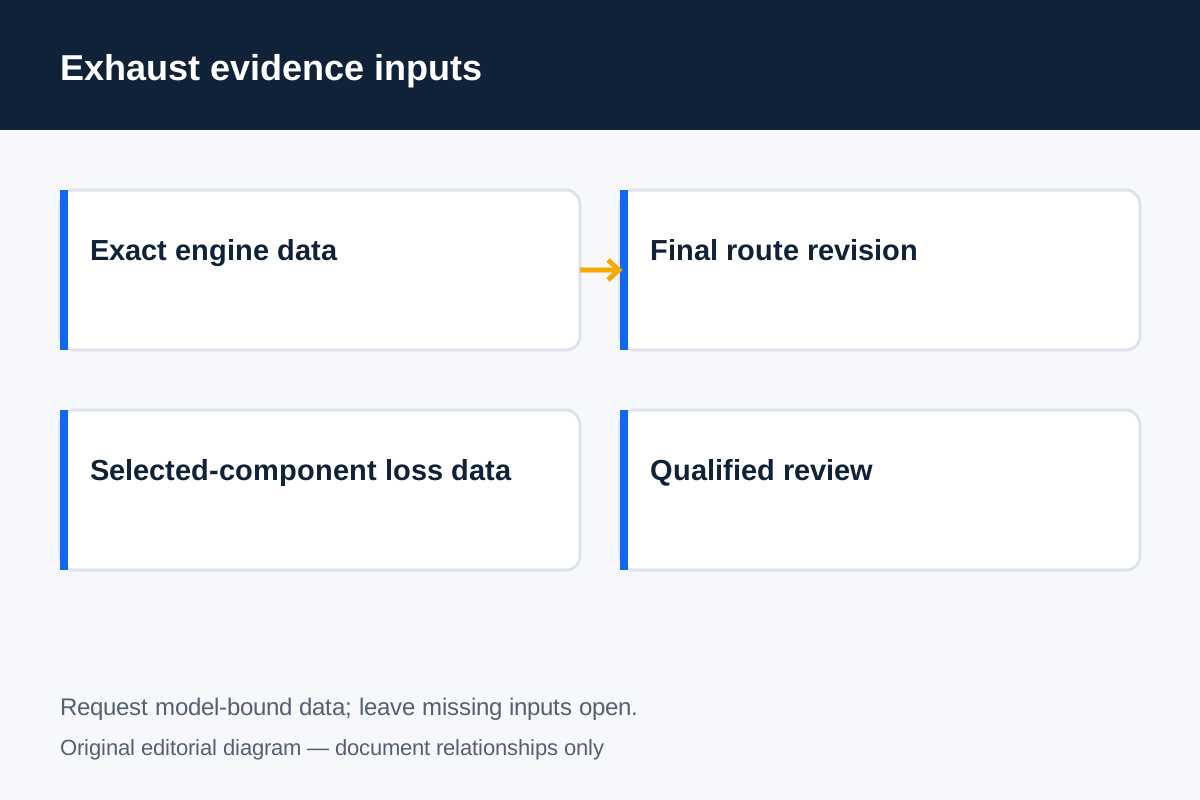
Ask the document provider to identify the quantity, units, reference point and operating condition. Keep a silencer pressure-drop figure labelled as component data. Do not relabel it as the installed system's outlet measurement or compare unlabeled figures as though they share a basis. Where the meaning is unclear, put that question in the open-item register for the designer and OEM.
Request the engine data before judging the pipe
Cummins T030 installation guidance (February 2015), sections 6.2.1 and 6.2.2.1, identifies different engine exhaust sizes and backpressure limits, engine-specific exhaust temperature, and engine-manufacturer exhaust gas flow. Those historical principles explain why the engine identity matters. They do not supply a transferable limit for a GENKVA or Weichai package.
Use the following original request register to organize the supplier documents. It is a procurement aid assembled from those source principles, not an OEM form or an engineering calculation. Leave unavailable entries open; a copied figure from another engine does not close the request.
| Request | Record with the response | Question if it is missing or unclear |
|---|---|---|
| Exact engine and generator package identity | Model identifier and the document's applicable configuration | Does this document apply to the engine in this quotation? |
| OEM exhaust gas flow | Document reference, revision, units and operating basis | Which condition does this flow describe, and who confirms its applicability? |
| OEM exhaust temperature | Document reference, revision, units and operating basis | Is the temperature basis consistent with the flow data used for review? |
| OEM backpressure limit | Exact engine reference, units and stated conditions | Which OEM document establishes the applicable limit? |
| Proposed duty and review basis | Project condition supplied to the designer, with unresolved assumptions visible | Which assumptions still require project or OEM confirmation? |
The value of the register is its traceability. A reviewer can see where each input came from and which questions remain unanswered. Procurement can request the missing document without turning a blank cell into an assumed specification. Record the responsible party beside each open item so the package does not depend on an informal verbal answer.
Give the designer the route and selected-component inputs
The same Cummins guidance includes flexible tubes, mufflers, elbows and pipes in its combined-loss review. It also says actual muffler-manufacturer data is more accurate than its typical graph. For a selected silencer, request the manufacturer's applicable loss data and its conditions rather than treating the silencer name or connection diameter as a pressure-loss result.
Give the qualified designer a route drawing with a revision identifier and an inventory of the actual proposed components. The following original ledger organizes the evidence to request. It deliberately contains no loss values: the designer determines what information and method the project requires.
| Input group | Evidence to provide or request | Open item for qualified review |
|---|---|---|
| Pipe route | Final proposed route revision and the pipe details shown on it | Are the lengths, sections and dimensions sufficiently identified for the chosen review method? |
| Elbows and fittings | Actual fitting identities and arrangement on the route | Which fitting loss inputs are applicable to this arrangement? |
| Flexible connections | Selected component reference and available manufacturer data | Is the component represented in the review, with its data basis identified? |
| Silencer or muffler | Selected model and manufacturer's applicable pressure-loss data | Do the data conditions match the review basis, or need confirmation? |
| Other proposed exhaust components | Identity, location and available loss evidence | Has the designer identified every relevant component and unresolved input? |
If a component is substituted, mark the changed row and ask the designer which parts of the review need updating. If the route changes, issue the new drawing revision with the ledger. This creates a clear evidence handoff; it does not imply that the procurement team has recalculated or accepted the system.
Keep design review and installed verification separate
Cummins' historical section 6.2.1 calls for estimating backpressure before the layout is finalized and measuring at the exhaust outlet under full load before service. These are two different checkpoints. Use that passage to ask how the applicable OEM and qualified project team will document their own requirements; do not turn it into a generic measurement procedure.
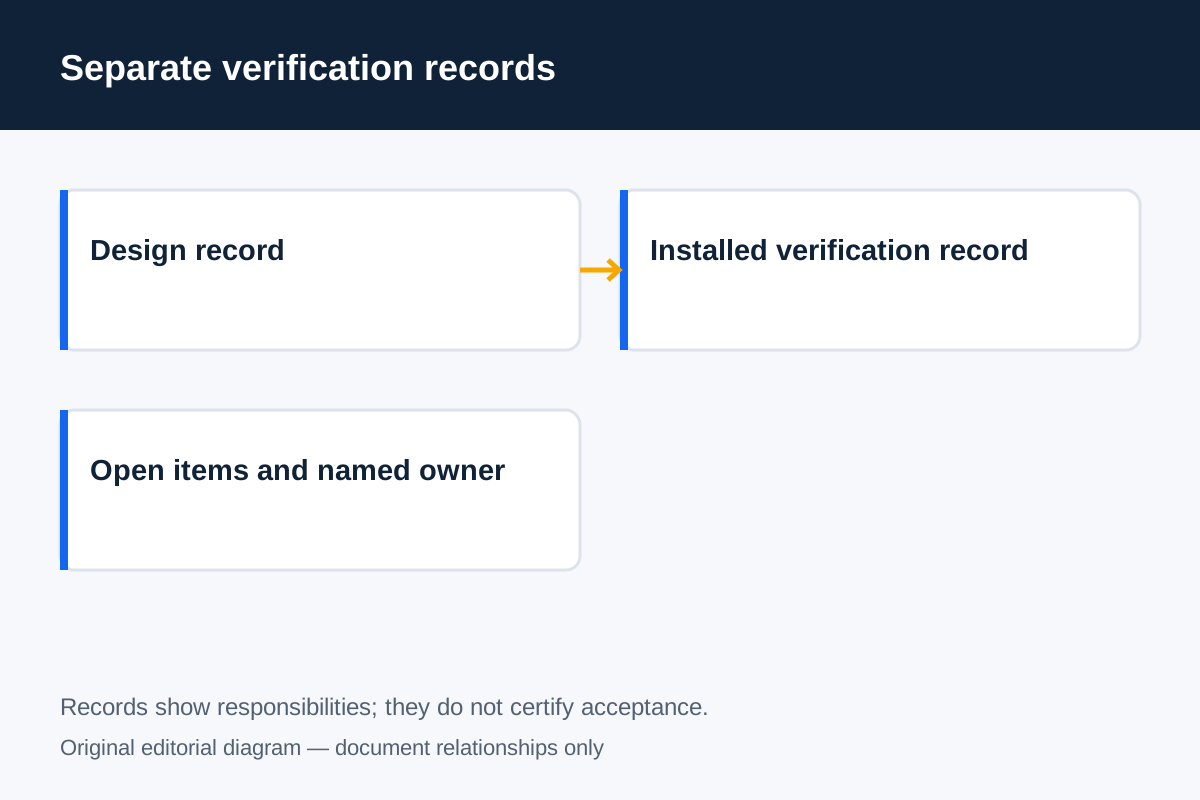
A design record should identify the engine data, route revision, selected-component inputs, review basis and responsible reviewer. An installed verification record should identify the actual configuration, applicable procedure, operating condition, recorded result and the responsible party's assessment against the applicable OEM requirement. The project professionals determine the necessary detail and acceptance; this article does not prescribe equipment, test setup or operation.
| Handoff record | Request from the responsible party | What remains open until documented |
|---|---|---|
| Design review | Reviewed route revision, input-document references and stated outcome | Missing data, assumptions or unresolved component substitutions |
| Installed configuration | Record of the actual installed arrangement and any differences from the reviewed design | Differences requiring the designer's assessment |
| Installed verification | Applicable OEM/project procedure reference, condition, result and assessment | Unperformed verification or an assessment not yet issued |
| Open-item closure | Named owner and the evidence needed to close each item | Any question without an identified response or closure record |
An estimate is not an installed measurement. Equally, an unlabeled reading does not explain its operating condition or establish that the right OEM limit was used. Ask the responsible party to reconcile the records. If a document is still unavailable, describe it as pending rather than saying the installation is approved.
Send an evidence pack with the project enquiry
For wider installation coordination, use the generator installation checklist alongside this focused exhaust register. Keep ventilation, fire, weather and other installation questions with the appropriate project professionals rather than treating exhaust backpressure as approval of the whole installation.
When you send a generator project enquiry, include the exact generator and engine identity, proposed duty, route sketch and revision, selected silencer details, and the OEM documents or open data requests. Ask which model-specific supplier documents are available and identify the questions that still need the OEM or project designer. Document availability and any review service must be confirmed for the project; an enquiry is not an engineering approval.
The useful next step is a traceable evidence pack. Keep the engine inputs, component ledger and installed verification handoff linked to the same project and revisions, with each unanswered question assigned to a responsible party.
Sources and scope
- Cummins T030, A040S369 Issue 9, February 2015, sections 6.2.1 and 6.2.2.1. The 2024 URL folder is not the publication date. Only verified readable passages are used; figures and numerical examples are excluded. Cummins T030 installation guidance (February 2015)
- DieselNet, Exhaust Back Pressure, revision 2007.03a: readable definition preview only. No paywalled detail or engine-specific limit is adopted. DieselNet exhaust backpressure definition
- The registers and diagrams are original editorial synthesis. They are not evidence of GENKVA engineering work, tests, customer installations, professional review or model capability.
- The exact engine OEM and qualified project professionals own applicable limits, design, test methods and acceptance. No universal numbers, calculation formula, measurement instructions, regulatory approval or warranty promise is provided.