
A procurement guide for collecting generator-source protection-study inputs. The worksheets are editorial collection aids, not a protection study, selected breaker setting, measured fault test or electrical approval.
A generator quotation can name the power class and include a circuit breaker while leaving an important project question unanswered: what happens to the protection review when that generator supplies the electrical system? The useful next step is to gather the right documents before treating the offered equipment as an accepted configuration.
This guide helps the buyer prepare that request. It follows the evidence from source identity to manufacturer data, installed protective devices and the person responsible for the study. It does not calculate fault current, choose trip settings or approve the electrical installation. If a required document is missing, the gap belongs in the quotation and review record.
A generator fault-current value needs a time context
Generator available short-circuit current can change with time. Multiquip’s Generator Short-Circuit Current paper describes a current that starts at a high value and decays as the event develops. Its discussion of generator modeling also explains why a decrement curve can be compared with a circuit-breaker trip curve. Those are bounded mechanisms; the paper's illustrated machines and numerical settings are not specifications for another generator.
For procurement, this changes the question from “What is the fault-current number?” to “What source response does that number describe, and what evidence will the study use?” An initial value, a later sustained value and a curve describing the event are different pieces of information. Do not substitute one for another because all three appear under a short-circuit heading in a datasheet.
The device review also has more than one purpose. The designer needs to address the available fault duty and the protective response in the project arrangement. A maximum-current figure alone does not show whether a particular device response is appropriate over the relevant time. Conversely, a trip curve does not by itself confirm the equipment's fault-duty suitability. Keep the source evidence and device evidence together so the study owner can assess their relationship.
Start by preserving the terms used in the supplied documents. Ask what fault condition, measurement basis, location and time interval the data describes. If a quotation states only “short-circuit current,” return that phrase as an open question rather than interpreting it as a complete curve. The manufacturer and project engineer need to resolve the basis; the buyer should not fill the blank with a generic multiple of rated current.
This distinction is separate from ordinary running-load sizing. A satisfactory kW or kVA shortlist does not provide the missing time-dependent protection evidence. Keep the load-selection record for its own purpose, then request the source and device information needed for this review.
Identify the source before requesting the curve
The first document in the package should identify the offered machine. Record the generator reference, alternator model, specified voltage, frequency and connection, and the configuration revision being quoted. Include the manufacturer's excitation description and any available regulator reference rather than assuming an arrangement from a product family name.
Multiquip's technical text identifies voltage, impedance and excitation support as relevant to available generator short-circuit current. It also shows that manufacturer modeling may represent excitation support in a particular way. That is why a curve received for a similar-looking generator needs a configuration check. It is not evidence that every model in the same kVA class has the same response.
Use an identity record to keep the request specific:
| Record to obtain | What it should identify | Open confirmation if incomplete |
|---|---|---|
| Offered generator reference | Quotation or order reference and equipment revision | Which exact offered configuration is being assessed? |
| Alternator identity | Manufacturer and model, with the supporting datasheet | Does the supplied curve belong to this alternator? |
| Electrical configuration | Specified voltage, frequency and connection as documented | Are the curve conditions consistent with the offer? |
| Excitation information | Manufacturer's stated arrangement and applicable support conditions | What conditions or restrictions accompany the fault-current data? |
| Document control | Filename, revision, source and the equipment reference it covers | Which document will remain attached to the final quotation? |
These fields are a collection method, not a statement that a particular GENKVA model uses a particular alternator or excitation system. If those details have not been selected, mark the proposed configuration as unresolved. A general brochure can support a shortlist, but it should not silently become the source model used in the protection study.
A later change to voltage, alternator or the offered configuration should be visible to the study owner. Keep the changed offer and its technical documents linked, and ask which study inputs need review. Do not carry forward an earlier conclusion without identifying the equipment and assumptions to which it applied.
Build a usable fault-current and breaker evidence package
Build the request around the documents the reviewer must connect. One side describes the source's fault-current behavior; the other identifies the actual protective devices and their response data. The project study supplies the context that relates them. A folder of unrelated datasheets leaves that work ambiguous.
The evidence-request matrix makes the package traceable:
| Evidence to request | Why the study owner needs it | Likely evidence owner | Question to keep open |
|---|---|---|---|
| Manufacturer decrement curve and supporting data | Review the source-current behavior over time for the specified machine | Generator or alternator documentation supplier | Which configuration, fault type and conditions does this curve cover? |
| Excitation description and conditions | Interpret the manufacturer model and its stated limits | Manufacturer documentation supplier | Is the applicable excitation arrangement represented in the supplied data? |
| Reactances and time constants, when requested by the engineer | Supply the modeling inputs required by the chosen study method | Manufacturer documentation supplier | What are the units, bases, definitions and applicable conditions? |
| Breaker, trip-unit or relay identification and response data | Connect the device in the installation to the correct curve or study model | Equipment or device documentation owner | Do the record and curve describe the actual device and existing settings revision? |
| Current system drawing and intended source modes | Locate the equipment and identify the cases the study is expected to address | Project electrical design owner | Which configurations and fault locations are included or excluded? |
| Study assumptions, conclusions and unresolved items | Make the technical review and approval responsibility explicit | Project protection-study owner | What is accepted, conditional or still awaiting evidence? |
The “likely evidence owner” column helps route a request; it does not assign a contractual duty automatically. Confirm who can provide each item for this project. Some files may already exist in the design package, while offered-machine documents may still need supplier confirmation. Keep their origins visible instead of treating every sheet as a factory-issued record.
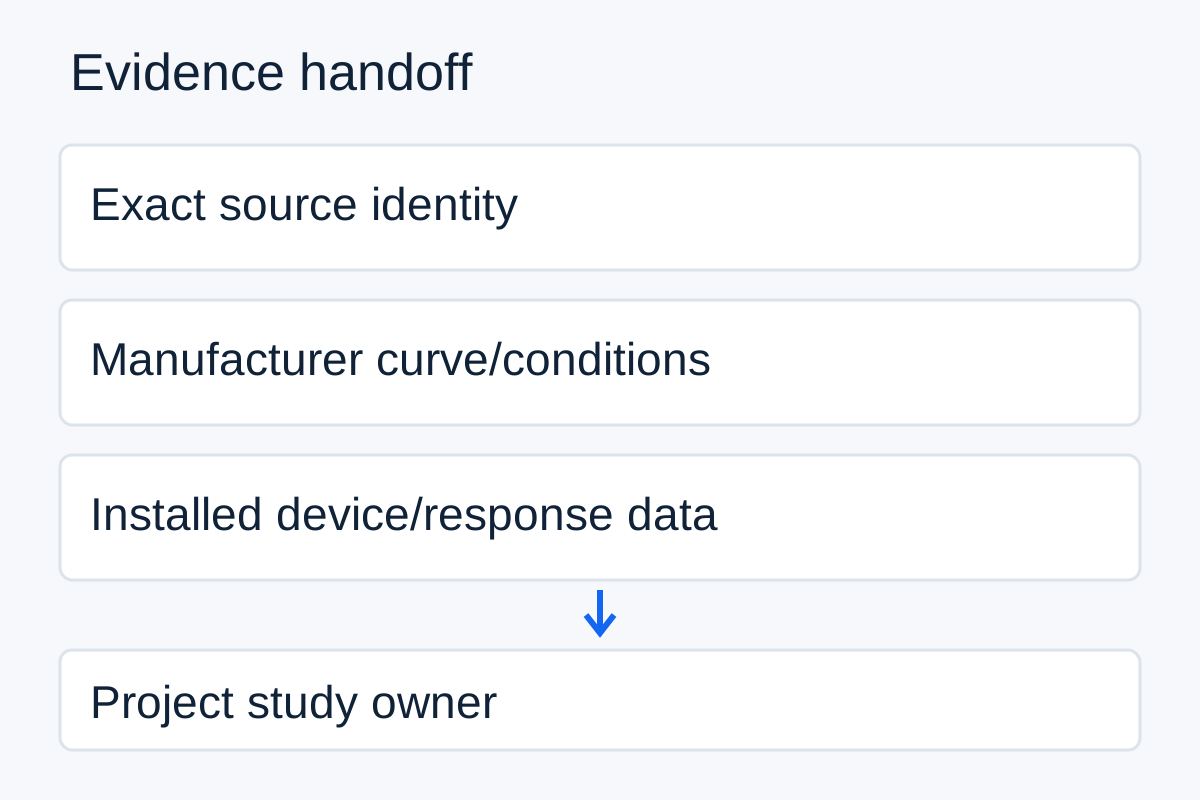
A curve needs its explanatory context. Record its equipment reference, revision, fault type, current units and basis, time units, and any stated operating or excitation conditions. Preserve manufacturer notes rather than trimming them away to fit a quotation. A curve image without its title or conditions may be readable, yet still be unsuitable as an identified study input.
| Curve-package field | Keep with the file | Follow-up question |
|---|---|---|
| Equipment and revision | Exact alternator or generator reference and document version | Does it match the configuration under review? |
| Fault condition and location | The fault description and point represented by the manufacturer | Is that the case the project engineer intends to model? |
| Current and time basis | Axis labels, units, definitions and explanatory notes | Are source and device data being interpreted on a compatible basis? |
| Modeling conditions | Excitation representation and other stated conditions or exclusions | Which assumptions require manufacturer or designer confirmation? |
| Source and availability | Original file, issuing party and any missing supporting pages | What remains unavailable before the study can close? |
The same discipline applies to protective-device records. A breaker frame description is not the complete identification of its trip unit or response data. Collect the installed or proposed device references and the existing approved settings record where available. This article does not tell the reader to alter settings; the assigned design and service professionals own that work.
When documents conflict, write the conflict as a question. For example, the offer may identify one alternator while the supplied curve names another reference. The response should confirm the relationship or replace the file, not ask the buyer to assume the two are equivalent. The package becomes useful when its documents can be connected to one reviewed configuration.
Keep each intended source mode in the review
List how the project actually intends to supply the system. A utility-source case and a generator-source case should be identifiable in the review record. If another operating mode is proposed, ask the design owner to define it and include or exclude it explicitly. Do not add parallel-generator operation merely because a technical paper discusses it.
The source-mode register is an editorial scoping aid:
| Intended case | Evidence attached to the case | Confirmation requested from the study owner |
|---|---|---|
| Utility supply, if part of the project | Applicable source information, system drawing and device records | Which utility-source assumptions and conclusions apply? |
| Generator supply | Exact offered-machine data, curve conditions and the relevant device records | Has this generator-source arrangement been addressed with the stated inputs? |
| Any other proposed source arrangement | Its documented equipment, connections and operating scope | Is it included, excluded or awaiting definition? |
| A changed equipment or drawing revision | Updated documents and the change description | Which previous assumptions or results need review? |
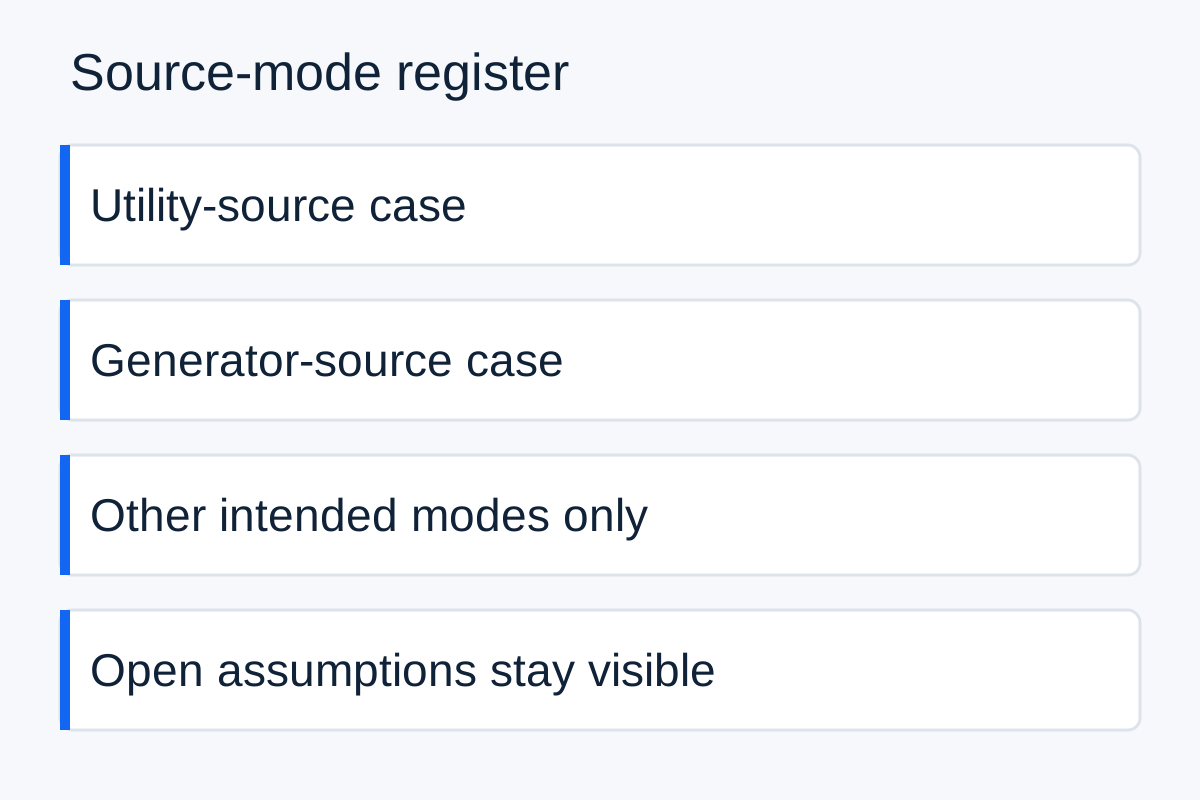
The point is to make the study's coverage visible, not to declare that one source is always more demanding. Do not assume a utility result proves generator-source response, or that a generator result proves every other intended mode. The project engineer must determine the relevant fault conditions, locations, equipment duties and device-response questions for the actual system.
Keep excluded cases visible too. An explicit “not included in this study” is different from an empty row that someone later interprets as reviewed. If the project scope changes, return the changed source mode to the study owner rather than applying a conclusion beyond its recorded basis.
Assign the response and keep open conditions visible
Before accepting the quotation's technical basis, agree who provides the machine documents, who supplies the installation and device records, who performs the protection study, and who approves the project conclusions. Those roles can be held by different parties. Receiving a manufacturer file does not mean the supplier has approved the complete site design.
A useful response names the reviewed configuration and addresses the evidence request item by item. It identifies the file provided, the conditions attached to it and anything still unavailable. The buyer can then distinguish a document request that has been answered from a technical conclusion that remains with the design owner.
Use a short response register alongside the quotation:
| Item | Response to retain | Closure evidence |
|---|---|---|
| Offered source identity | Confirmed equipment reference and configuration revision | Matching quotation and manufacturer documents |
| Manufacturer data | Files provided, applicable conditions and missing information | Identified curve and supporting documentation |
| Installed device and system records | Responsible party and the version supplied | Device references, current drawing and approved records |
| Protection study | Named study owner, included scope and open assumptions | Project review deliverable and its stated disposition |
| Unresolved confirmation | Exact question, responsible party and required response | Written answer or explicit condition before acceptance |
This is a prospective handoff method. It is not a completed customer study or a manufacturer-approved form. Do not mark an item closed solely because a quotation includes a breaker or because a brochure lists a power rating. Closure needs the response appropriate to that item and the person authorized to evaluate it.
For equipment identification and site handover context, use the existing generator commissioning preparation guidance. GENKVA asks for generator, engine, alternator and controller identity and retains equipment and handover records. The project electrical review remains separate, and installation and energized testing belong to qualified local professionals under the applicable approved procedure. Nothing in this guide is an instruction to create a fault, bypass protection or change a live setting.
Keep the study's inputs attached to the offered configuration through the final commercial discussion. If the equipment, drawing or intended operating mode changes, document that change and ask the study owner what it affects. A larger kVA offer or a different breaker label is not a documented answer to an unresolved protection-study question.
Request generator documentation with your project inquiry. Include the offered-machine reference, source-mode register, existing device records and the open-confirmation list. Ask for the equipment documentation available for that configuration, and identify anything that still requires manufacturer or project-engineer confirmation. The next useful handoff is a traceable evidence package with clearly assigned technical responsibility.
Sources and method
- Multiquip, Generator Short-Circuit Current: printed pages 2, 10, 18 and 22 support the bounded discussion of time-dependent current, voltage/impedance/excitation context, manufacturer modeling and decrement/trip curve comparison. The saved source's publication date is not asserted. Its numerical calculations, settings, model examples, figures and historical standards references are not adopted as GENKVA specifications or current project requirements.
- GENKVA's commissioning-preparation and quotation destinations provide the first-party equipment-identification and inquiry context. They do not demonstrate a particular generator's protective capability or a complete project-study service.
- The identity table, evidence-request matrix, curve-package record, source-mode register, response register and two diagrams are original editorial collection methods. They contain no measured fault test, certified result or customer case.
Final protection selection, study acceptance and electrical approval require the actual equipment, installation inputs, manufacturer information and responsible project professionals. This guide provides the document-request process and preserves those limits.