
Map what the UPS must do during an outage
Start with the operating sequence rather than a generator-to-UPS multiplier. A UPS can bridge the interruption while a backup generator starts supplying power, but the project's usable battery runtime and transfer timing still need to be documented. Ask the UPS supplier and project designer what the selected system must do between losing utility power and accepting the generator source. Do not substitute a typical startup time for the project's agreed sequence.
CyberPower's UPS and generator explanation describes how changing generator loads can produce frequency variations that cause some UPS systems to switch to battery. Seeing a generator run therefore does not establish that the UPS is accepting its input. The response depends on the actual UPS, settings and conditions, so record both the intended state and the evidence needed to confirm it.
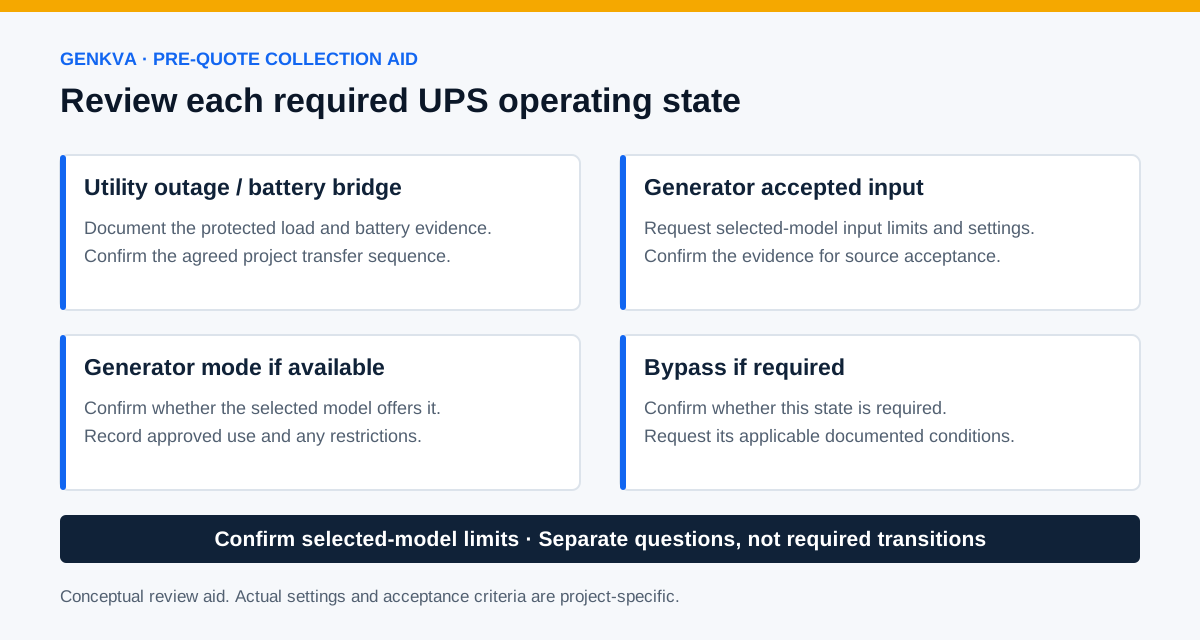
The following matrix can be copied into a request for quotation. It names proposed review responsibilities; agree the actual allocation with the project team.
| Operating state to review | Document or input to request | Proposed review responsibility | Question to close |
|---|---|---|---|
| Utility outage and battery bridge | Protected-load schedule, usable battery-runtime evidence and project transfer sequence | UPS supplier and project designer | What must remain supported while the generator source becomes available? |
| Accepted generator input | Selected-model input limits and configured values, with manual references | UPS supplier provides conditions; generator supplier reviews the supplied specification | Which conditions must be satisfied for the UPS to accept the proposed source? |
| Generator mode, if available and required | Selected-model description of the mode, configuration changes and restrictions | UPS supplier and project designer | Does this model offer the mode, and is it part of the approved design? |
| Bypass, if required | Applicable bypass conditions and the project requirement for bypass on generator power | UPS supplier and project designer | Is this state required, and who confirms its applicable limits? |
These are separate review questions, not a required sequence through all four states. A project may not require bypass on generator power, and its UPS may not provide a generator-mode setting. Record those decisions explicitly instead of leaving an empty box that another supplier may interpret differently.
Ask for the selected UPS input and bypass limits
An online double-conversion UPS converts incoming AC power to DC and back to AC. CyberPower describes this topology as a way to handle incoming frequency variations, and identifies a generator-mode setting on some of its products. Those general descriptions explain the buying question, but they do not confirm every online UPS with every generator. Retain the selected model's documentation and configured settings in the project brief.
Dale's guidance on UPS voltage and frequency acceptance explains that a UPS may reject a generator source outside its accepted voltage or frequency limits and use its batteries instead. Ask for the actual limits applicable to your UPS and operating mode. A nominal voltage and frequency on two nameplates is useful identification information, but the review also needs the documented acceptance conditions.
For each limit, keep a traceable reference: UPS make and model, document title or manual number, revision, page or section, operating state and configured value where relevant. Ask the UPS supplier to identify normal input conditions separately from bypass conditions. Do not assume that a value quoted for one state also applies to another.
If someone proposes enabling generator mode, request the selected model's explanation of what that mode changes and any restrictions that accompany it. This article does not prescribe enabling a setting or widening an acceptance window. That decision belongs in the controlled project design and the relevant manufacturer's instructions.
When documentation does not answer a question, label it to be confirmed by the UPS supplier. A visible unresolved item is more useful than a guessed limit in a quotation spreadsheet. It also lets each generator supplier price and review the same stated assumptions.
Separate the load from the recovery demand
GENKVA's data-center generator planning inputs request UPS input data, efficiency, power factor, harmonic characteristics, bypass condition and battery-recharge settings, together with cooling and other support loads. Prepare those inputs as separate records. A protected-equipment load figure should not silently stand in for the complete UPS input information requested for the review.
This is a document-collection task, not a sizing formula. Keep the units and basis attached to each entry: whether a supplied figure is input kVA, input kW or input current; whether it is a rating or a measured operating value; and which load level and mode it describes. Ask the UPS supplier for efficiency, input power-factor and harmonic information relevant to the proposed operation. If a value is unavailable, retain the gap rather than deriving it from a different model's brochure.
| Input to collect | What to attach to it | Confirmation needed before the quote is treated as settled |
|---|---|---|
| Protected load | Current load schedule and any separately stated future allowance | Which load basis the project wants reviewed |
| UPS input demand | Selected-model input kVA, kW or current information, with units and operating conditions | Which supplied values apply to the proposed configuration |
| Efficiency, input power factor and harmonics | Relevant OEM data or a project measurement report | Applicability to the reviewed load level and operating state |
| Battery recharge | Documented charger settings, any configured current limit and the intended recharge condition | The setting and demand assumptions to use in the review |
| Bypass | Whether bypass on generator power is required, with the applicable conditions | Who confirms that operating state and its limits |
| Cooling and support loads | A separate schedule showing which loads return with the UPS modules | Which loads are simultaneous and which are separate steps |
The distinction between a rated figure, a configured setting and a measured value should remain visible throughout the quotation. If a spreadsheet simply says “UPS input,” ask which document and operating condition that entry represents before it is used. This prevents different suppliers from answering different versions of the same request.
Treat battery recharge as its own question in the schedule. Request the project's intended recharge settings and ask how the UPS supplier wants those settings represented in the generator review. Do not insert a percentage or extra capacity allowance from an unrelated UPS model. The purpose is to give the reviewer actual project assumptions, not to manufacture a final demand figure from incomplete information.
Write down the actual reconnection sequence
GENKVA's data-center application brief also asks which UPS modules and cooling loads reconnect at each step, and what voltage and frequency deviation the project allows. Put those questions into a short sequence sheet that travels with the load schedule. A steady operating total and a sequence of reconnection steps describe different parts of the proposed operation; both should be visible to the reviewer.
For each step, record the returning UPS modules, cooling or other support loads, the initiating control or event, and the project-defined acceptance condition. Identify which entries are confirmed and which are proposed. If the project has not established the order or timing, leave a clear design-team confirmation item rather than presenting an invented schedule as an approved control strategy.
Include the return-to-utility portion of the requested review. Ask the responsible project team which UPS state, recharge condition and bypass requirement need to be considered during that return. The checklist exposes that question without prescribing a transfer arrangement or a commissioning procedure.
A useful handoff makes responsibility explicit. The UPS supplier provides the relevant UPS documentation and configuration information; the project team identifies the required sequence and acceptance criteria; the generator supplier reviews the generator-set portion against that controlled specification. Agree who will resolve each open item and how the reviewed assumptions will be recorded. This is procurement preparation, not an instruction to perform live transfer tests or change energized-system settings.
Send a controlled generator/UPS brief
Before requesting a final generator selection, assemble one identifiable package rather than several disconnected nameplate photographs. Give the package a revision or other agreed identifier so each supplier can refer to the same documents. The following checklist is an editorial collection method, not a compatibility certificate:
- Identify the UPS configuration. Include make, model, topology, relevant module configuration and the manuals or supplier documents used for the review.
- List the required operating states. Record the battery bridge, accepted generator input, generator mode if available and required, and bypass if required. Mark genuine exclusions explicitly.
- Attach applicable limits. Include model-specific input and bypass conditions with document references and configured values where relevant.
- Keep demand inputs separate. Supply the protected-load schedule, UPS input data, recharge settings and cooling/support-load schedule with units and operating conditions.
- Describe recovery. State which loads reconnect at each step and supply the project-defined timing, allowable deviations and acceptance criteria.
- Expose unresolved assumptions. Name the responsible party for each missing value and say whether the quotation is provisional until that item is confirmed.
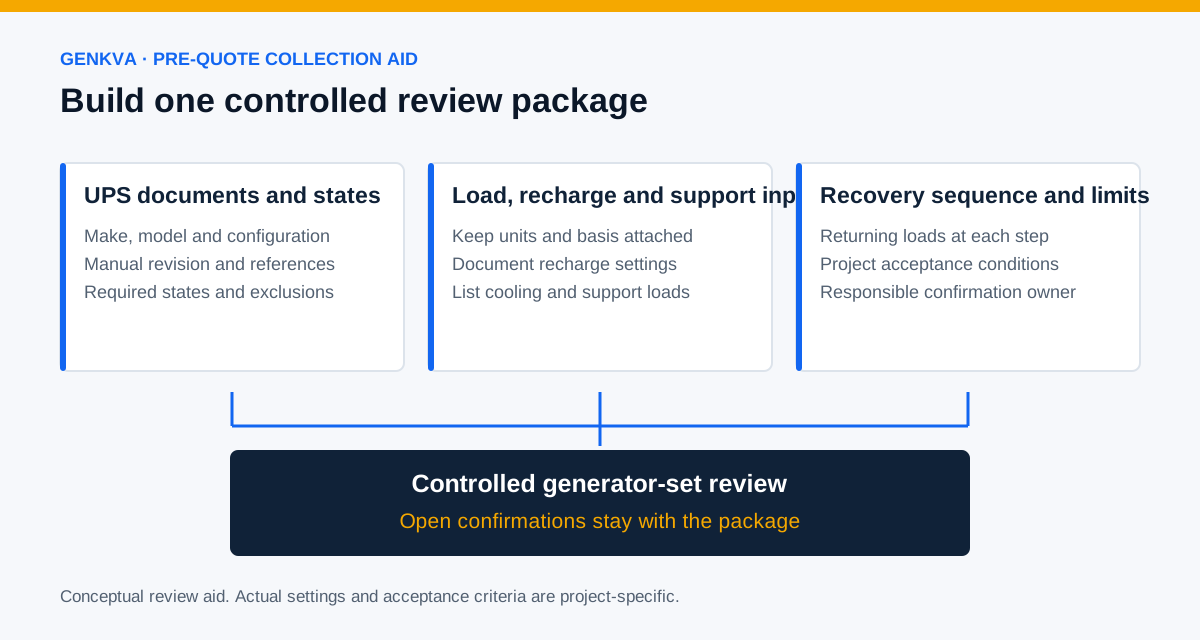
Compare quotations against this package. Ask each supplier to identify the document revision used, the generator-set configuration reviewed and the assumptions still open. If two quotations use different recharge settings or simultaneous-load assumptions, resolve that difference before comparing the proposed generator sizes or prices. This method makes the scope reviewable; it does not establish a universal generator-to-UPS sizing ratio.
GENKVA describes its data-center role as reviewing the generator-set portion against the controlled project specification. The UPS configuration and complete system-design decisions still require their responsible parties. Once the inputs above are assembled, request a generator quotation with this UPS brief, including the selected-model documents and the remaining confirmation items. That gives the enquiry a concrete basis without implying that the quotation itself is complete system approval.
Sources and scope
- CyberPower: How a UPS System Works with a Backup Generator, published May 19, 2021. Used for the general AC/DC/AC description, battery bridge, frequency-related battery behavior and the existence of generator mode on some products. Its capacity heuristics are not adopted here.
- Dale Power Solutions: How to ensure compatibility with your UPS and generators. Used as specialist supplier guidance on input acceptance; the checked source displays its date as 01/11/2022.
- GENKVA's existing data-center application source supplies the requested project-input list and the stated generator-set review boundary. No particular GENKVA generator, UPS pairing, operating limit or performance result has been verified by this article.
Bring the selected UPS documents and open confirmation items with your enquiry.
Request a generator quotation