
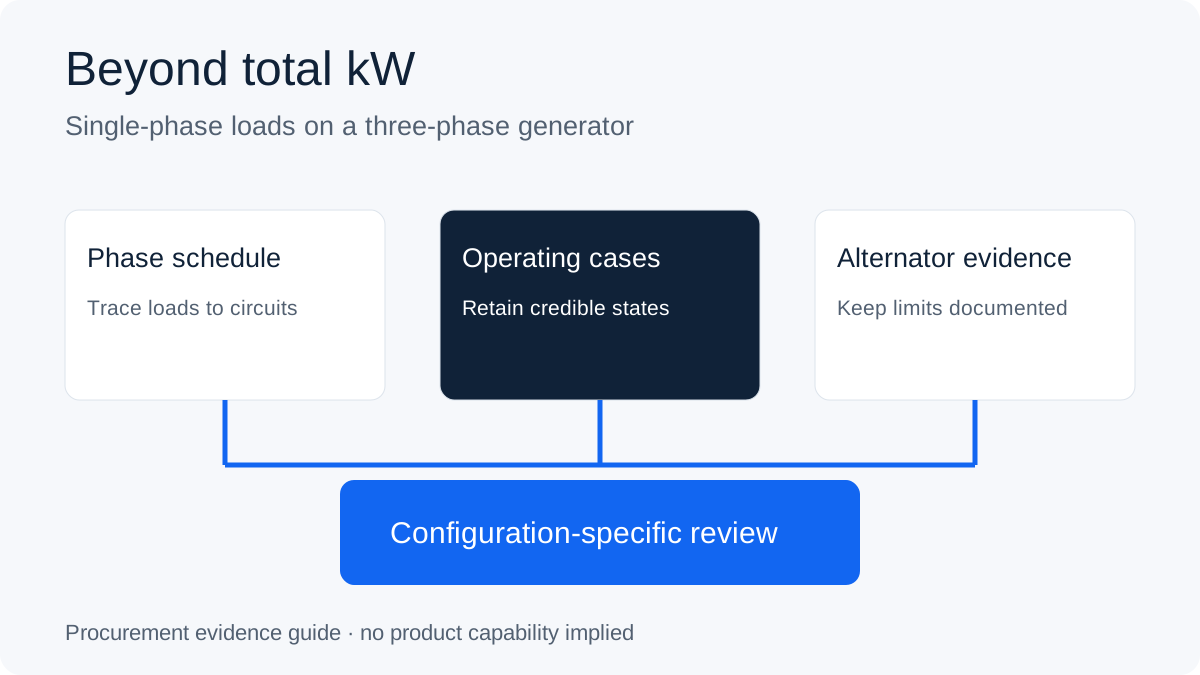
A procurement guide for mixed single-phase and three-phase loads. The example and worksheets are editorial methods, not a measured installation, generator sizing result or electrical design approval.
Single-phase loads on a three-phase generator raise a question that a total-load spreadsheet can hide: where does the demand sit? A total is useful, but it cannot show which circuits remain online on each phase or which alternator restrictions apply to that combination. Before comparing quotations, keep the phase information attached to the load information.
The goal is a reviewable specification. The buyer gathers the load and operating evidence; the project designer confirms the electrical allocation; the supplier identifies the proposed alternator and the conditions it can support. Missing information stays visible in the quotation instead of becoming an assumption behind a larger headline kVA.
The total can stay the same while the phase allocation changes
Consider two fictional allocations of branch-load real power. Each totals 36 kW, but they describe different distributions:
| Illustrative allocation | Phase A | Phase B | Phase C | Total real power |
|---|---|---|---|---|
| Even allocation | 12 kW | 12 kW | 12 kW | 36 kW |
| Unequal allocation | 24 kW | 6 kW | 6 kW | 36 kW |
The second row is not proof that phase A is overloaded. No generator model, phase current, power factor, supply arrangement or applicable limit has been specified. It only shows why the same total can lead to different application questions. Both rows require a proper configuration review before either can be accepted.
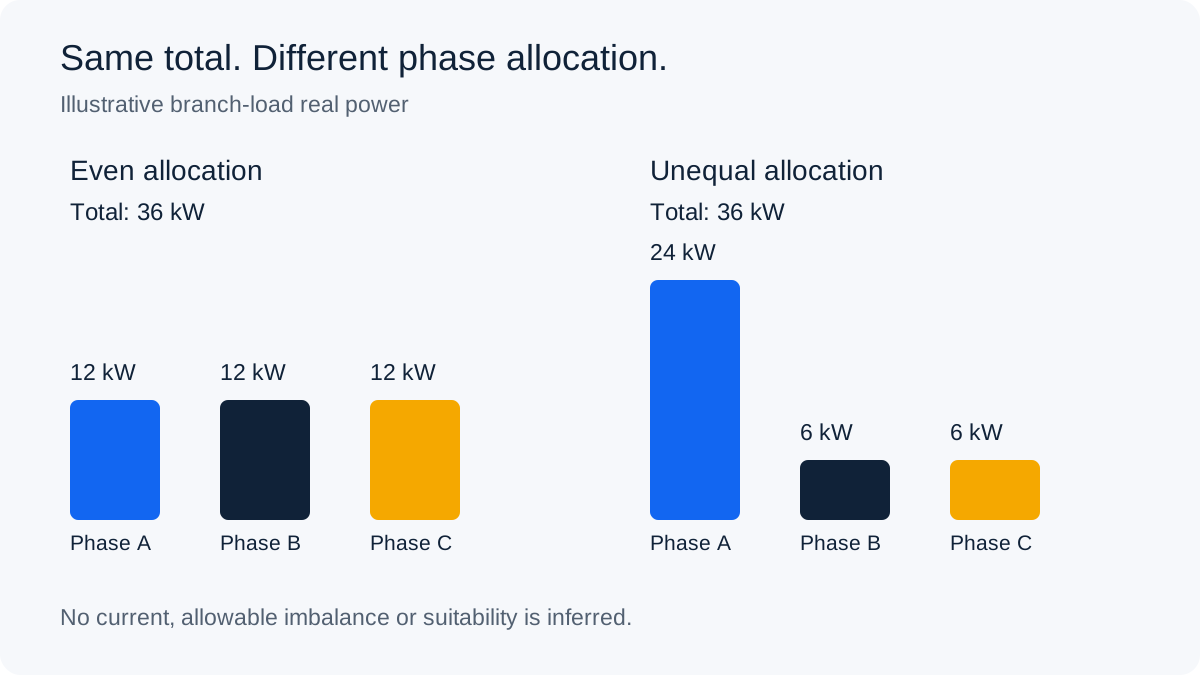
Keep the distinction between real-power allocation and electrical acceptance throughout the review. A supplier needs the actual electrical data and the proposed machine's application limits, not just a colored chart. Do not turn a kW share into an allowable-current percentage or assume that dividing total generator output into three equal parts produces an approved single-phase rating.
This is also why “the total is below the generator rating” is an incomplete response to a phase-loading question. It answers the aggregate comparison while leaving the distribution and alternator conditions unresolved. The useful follow-up is to request a phase-specific assessment of the documented operating cases.
Build a load schedule that preserves the phase basis
Start with the project load schedule and electrical drawings, rather than assigning phases from equipment names. A circuit may be single-phase or three-phase, and its actual supply arrangement matters. Have the designer identify the phase-neutral or phase-pair basis where applicable; this guide does not provide circuit assignment or connection instructions.
Use one row per identifiable load or circuit. Keep the source of each number beside it so a nameplate rating, a measured input and a planning allowance do not silently become interchangeable. Where a value is unavailable, mark it as an open input with an owner who can obtain or confirm it.
| Schedule field | What to retain | What remains to be confirmed |
|---|---|---|
| Load or circuit identity | Equipment name and drawing or circuit reference | Whether another row already includes the same demand |
| Supply and allocation | Single-phase or three-phase; actual phase or phase-pair assignment from the design | The arrangement and voltage applicable to that load |
| Electrical input basis | Documented current, or kW/kVA and power factor where supplied | Which values describe the intended operating condition |
| Evidence source | Nameplate, manufacturer document, measurement record or stated planning assumption | Date, condition and relevance of the record |
| Operation | When the load is online and which other loads operate with it | Credible simultaneous combinations |
| Duration and duty | The expected sustained interval for each case | Any application restriction that depends on duration |
| Unresolved item | The missing value, assumption or allocation question | Responsible party and the document needed to close it |
Keep three-phase entries intact until the electrical basis for their allocation has been confirmed. A buyer's spreadsheet should preserve design information, not invent an equal split to make its columns look balanced. The same caution applies to a single-phase load whose current or supply basis has not yet been documented.
If the schedule mixes running kW, apparent power and current, the running-load and kW/kVA input guide helps organize those inputs. Bring their voltage, power-factor and source context into the phase schedule. An unsupported conversion does not become reliable merely because the final spreadsheet total is precise.
The completed schedule should let another reviewer trace a phase total back to its contributing circuits and documents. That trace is more useful than a rounded aggregate number with no explanation of how it was assembled.
Compare the credible sustained operating cases
The configuration that has the largest total demand is not automatically the only phase-loading case worth reviewing. If loads on other phases switch off while one group remains online, the total can fall and the distribution can change. Which case governs the application depends on the actual loads and the manufacturer's conditions; it cannot be selected from total kW alone.
Define cases that correspond to how this project can actually operate. Normal operation, an essential-load condition and a minimum-load condition are possible worksheet labels, not a prescribed operating sequence. Replace them with the project's real states and show how each is achieved.
| Candidate case | Loads online | Phase evidence to attach | Open confirmation |
|---|---|---|---|
| Normal operating condition | The documented simultaneous load set | Circuit schedule and declared electrical input basis for each phase | Whether the proposed alternator supports this sustained combination |
| Essential-load condition | The circuits that remain under the project's load-selection scheme | Updated phase allocation after the excluded circuits are removed | Whether the changed distribution needs a different application restriction |
| Minimum operating condition | The smallest credible combination that can remain online | The remaining branches, their phase basis and expected duration | Whether that case is covered by the supplier's stated conditions |
Do not assume that every possible switch combination must be modeled. Choose credible states with the project team, then record the reason for including or excluding each. Where an operating rule is relied on to prevent a particular combination, identify that rule and who is responsible for confirming it.
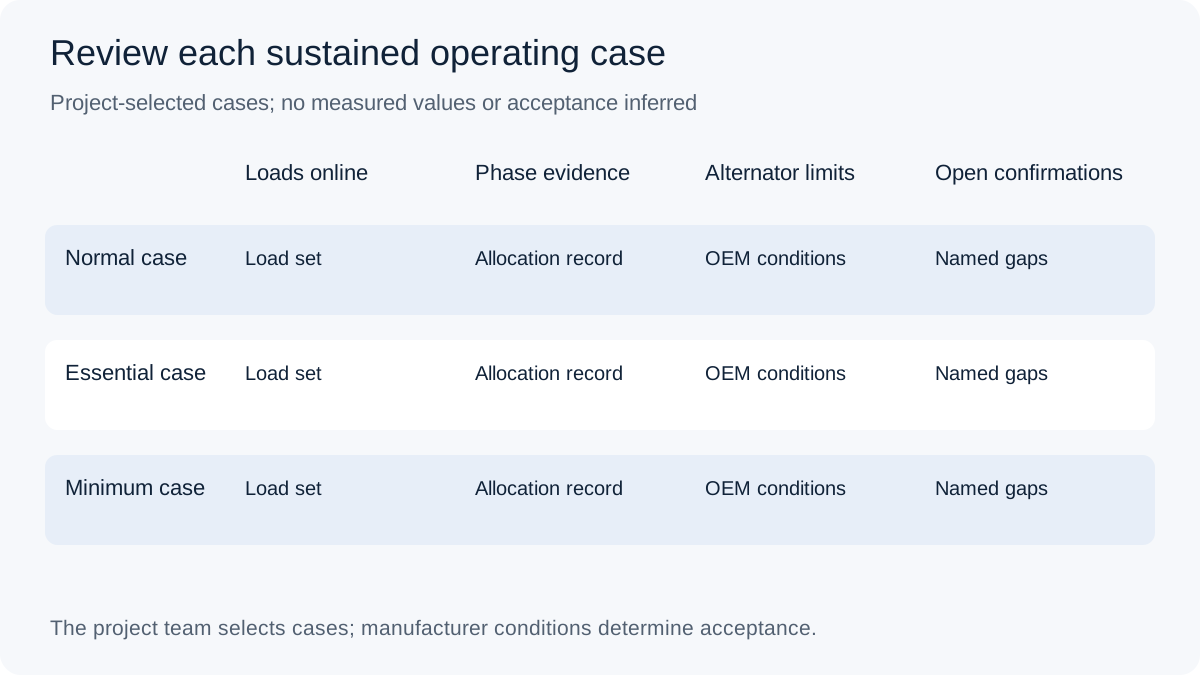
Keep a separate row for the assumptions behind each case. A schedule based on an expected operating habit should not be reported as an enforced sequence without supporting evidence. If a combination remains uncertain, send it as an unresolved case rather than excluding it to obtain a simpler quotation.
This article addresses sustained allocation. Motor-starting and UPS behavior are additional questions when those loads are present, but their transient or operating-state checks do not replace the phase-specific review. Preserve those as separate inputs in the project specification instead of using one check as a substitute for another.
Ask for the exact alternator application limits
STAMFORD's AGN017 guidance on unbalanced loads explains that unequal phase loading can produce unequal phase voltages. It also describes uneven or pulsating electrical loading and torque demand under single-phase loading, and connects unbalanced-current conditions with thermal stress in machine components. These are reasons to examine the application, not predictions of temperature, vibration or failure for a particular generator set.
The note discusses application restrictions and configuration-specific single-phase ratings for Cummins Generator Technologies alternators. Its examples should not be transferred wholesale to an unspecified alternator. Ask for the proposed manufacturer's applicable guidance, the exact alternator model and winding or configuration information needed to establish which conditions apply.
The evidence request should identify the quantity being limited. Phase-load distribution, phase-current imbalance and voltage imbalance describe different information. A reply that gives only “maximum imbalance” without its definition, operating condition and document reference leaves an important ambiguity. Ask the supplier to state what is measured or calculated, how the offered configuration is assessed, and which limits govern the submitted cases.
Duration belongs in that response too. The application's sustained cases should be compared with the conditions the manufacturer actually specifies. Do not insert a universal allowable percentage, derating factor or standards claim when the exact machine and documentation have not been established.
AVR sensing is another item to identify, with a limited purpose. AGN017 discusses three-phase sensing in relation to voltage regulation, but sensing should not be treated as evidence that unequal loads have been redistributed or that a submitted application is accepted. Record the proposed regulator and sensing arrangement as part of the machine information, then retain the separate application confirmation.
If the supplier proposes another winding or generator configuration, request its documented rating and application conditions as a new offered configuration. Compare the evidence against the same load schedule and operating cases. A proposal to change configuration is not an instruction for the buyer to reconnect an alternator; that work belongs to the qualified design and manufacturer process.
Send a phase-specific evidence package with the quote
GENKVA's generator model shortlist provides a starting point for comparing confirmed power classes. The owner page still requests electrical and site requirements before the final configuration is confirmed. Bring the phase schedule into that step so the shortlist and quotation refer to the same project inputs.
A useful quotation package contains:
- The actual supply arrangement and designer-confirmed phase or circuit allocation.
- Per-load electrical inputs with their source and operating basis.
- Credible sustained cases, including loads removed from service and the expected duration of each case.
- The project's duty and site requirements.
- The proposed alternator model, winding or configuration, and relevant regulation information when offered.
- The applicable manufacturer's restrictions, evaluated cases and any unresolved confirmation.
Then record the supplier's response against the evidence requested. The register below makes an unanswered configuration question easier to find than a general statement that a generator is “suitable.”
| Confirmation | Response to retain | Question to keep open when missing |
|---|---|---|
| Offered configuration | Exact alternator identification and relevant winding/configuration documents | Which machine and application conditions does this quote cover? |
| Applicable limits | The manufacturer's document, quantity, condition and restriction used | Is the cited limit applicable to this offered configuration? |
| Operating cases | A reference to each submitted case and the stated basis for accepting it | Which credible case has not been assessed? |
| Assumptions and gaps | The input assumed, its source or limitation, and the party responsible for closure | What evidence is needed before configuration confirmation? |
Compare quotations case by case. A larger headline kVA does not close an undocumented phase-loading condition, and a configuration-specific response should not be applied to a different offered machine without review. Keep the load schedule's version attached to each quotation so a later change to the circuit mix does not disappear from the discussion.
When an input or manufacturer confirmation is still missing, say exactly what remains unresolved. This keeps an early commercial quotation useful without presenting it as full system approval. The responsible project engineers and manufacturer provide the actual electrical acceptance criteria and configuration assessment.
Request a generator quote with the phase load schedule, the operating-case matrix and the open-confirmation register. Include the proposed alternator details if already available; otherwise make their identification part of the request. The next useful step is a quotation tied to those inputs and documented limits.
Sources and method
- STAMFORD | AVK — AGN017, Unbalanced Loads, Issue E. The retrieved eight-page manufacturer's application note supports the discussion of unequal loading, voltage regulation, torque and thermal concerns, and configuration-specific restrictions. A publication date is not supplied here. No numerical limit or standard-compliance conclusion from that note is adopted as a universal rule.
- The GENKVA generator-model and quotation pages provide the commercial next-step context. The phase schedule, operating-case matrix and response register are editorial collection methods, not manufacturer-approved forms.
- The 36 kW comparison is hypothetical arithmetic: 12 + 12 + 12 and 24 + 6 + 6 both equal 36. It is not measured evidence, a customer case, a current calculation, a derating result or proof that either configuration passes.
Final generator selection and electrical design require the exact equipment, project inputs and applicable manufacturer's review. This guide provides no wiring, alternator-reconnection or live-test procedure.