
How to read a Weichai generator engine code, segment by segment
Weichai numbers its high-speed engines by a written designation rule that has been revised several times since 2004. We could not retrieve that rule from a Weichai-hosted page. The version used here is a reproduction published in 2019 on 100VR, a Chinese vocational-training platform, and a 2014 Truck Home (360che.com) explainer confirms its prefix, series, fuel, power and emission segments for truck engines. Read against that rule, a generator engine code breaks down like this:
| Segment | In WP10D200E200 | What the rule says it means |
|---|---|---|
| WP | WP | Weichai Power, the brand prefix |
| Series code | 10 | Product series, numbered by displacement (WP10 = 9.726 L) |
| Fuel code | (none) | No letter means diesel; NG would mean natural gas |
| Use code | D | Land power generation (Q is vehicle, G construction machinery, T tractor, C marine main engine, CD marine generating set, B pumps and other stationary power) |
| Power | 200 | Engine power in kW for generator engines |
| Emission stage | E2 | Emission stage code; the rule maps E1 to E5 to China stages I to V and E6 to Euro VI |
| Variant | 00 | Variant or product-series number |
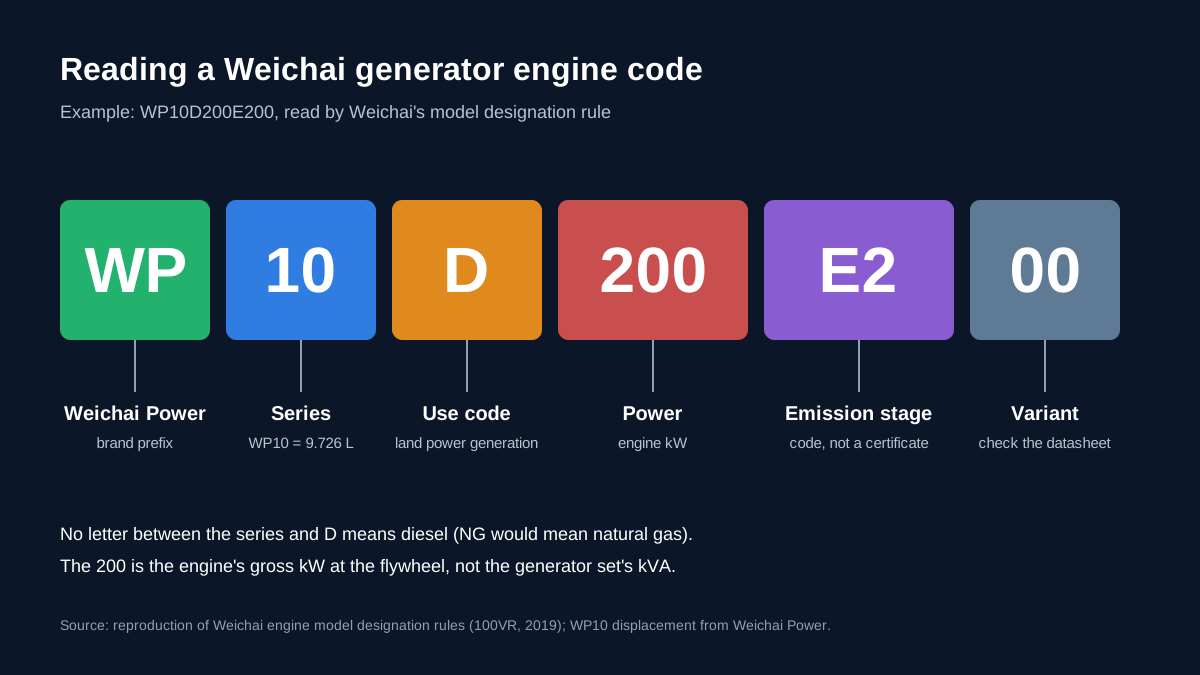
Two details trip up buyers who compare codes across catalogs. First, generator engines have been numbered in kilowatts since 2010, when the rule changed "horsepower to kilowatts" for generating-set diesels. Truck codes in the 2014 Truck Home explainer carry horsepower, which is why a truck code such as WP10.336E40 means 336 hp while a genset code such as WP10D200E200 means 200 kW. A Zichai explainer describes Weichai's marine engine naming the same way, using a marine model (WHM6160C520-2) rather than a WP code: horsepower for main propulsion engines, kilowatts for auxiliary and land engines. Second, the trailing digits after the emission code are not decoded in either source beyond "variant" or "product series". Truck Home notes that a different final digit can mean a different structure and different performance. Treat E200 and E201 as different configurations, and confirm what the difference is from the datasheet, not the code.
WP4 is not WP4.1: series codes and the missing dot
Searchers often type Weichai codes without punctuation, such as wp4d66e200 for the engine in GENKVA's 62.5 kVA set. The dot is not decoration. The rule's displacement table lists WP4 and WP4.1 as two separate series, and one distributor's series list names them separately as well:
| Series code | Displacement in the rule's table |
|---|---|
| WP4 | 4.5 L |
| WP4.1 | 4.087 L |
| WP6 | 6.75 L |
| WP10 | 9.726 L |
| WP12 | 11.596 L |
| WP13 | 12.54 L |
By the rule, then, the dot changes which engine series a code names. We found no listing for a WP4D66E200 product, so a code written that way may be WP4.1D66E200 with the dot dropped, or it may refer to a different WP4 engine. GENKVA's pairing uses WP4.1D66E200. If a quotation, nameplate or parts request shows WP4 without the point, confirm the engine against its nameplate or datasheet before comparing prices. WP2.3, the series in GENKVA's 37.5 kVA set, does not appear in the table we retrieved, so for that engine rely on its datasheet for displacement.
The number after D is an engine rating, not the generator's kVA
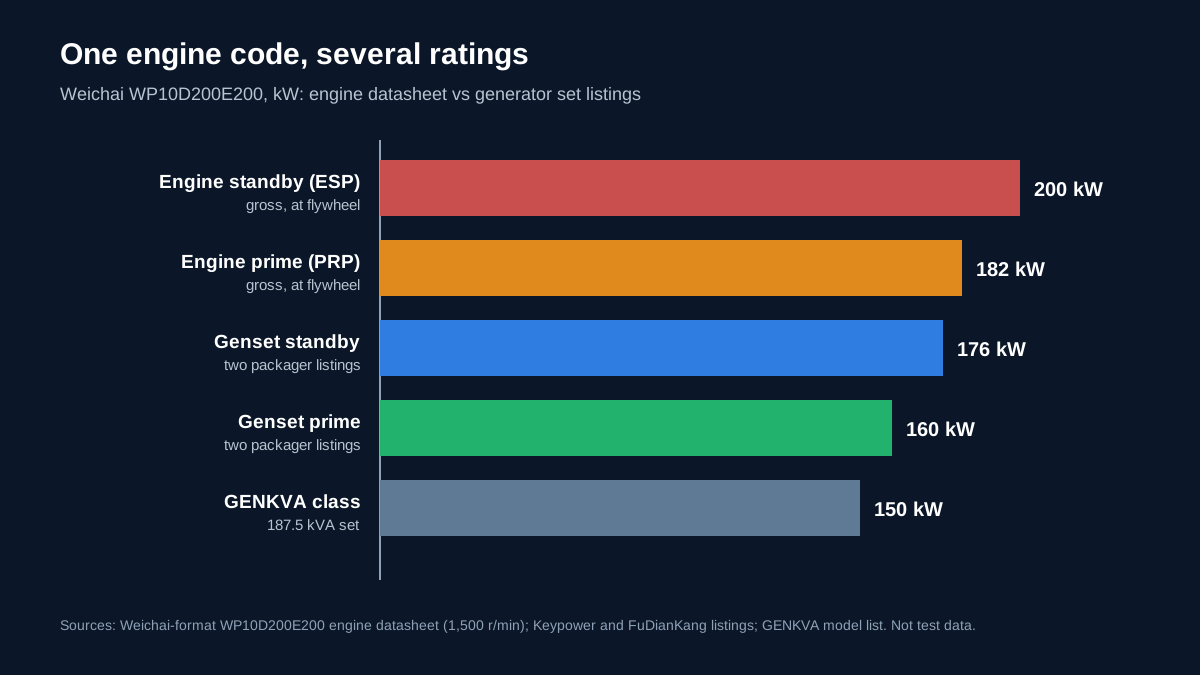
The power figure in the code describes the engine, not the generator set, and the only Weichai-format datasheet we could retrieve shows how the two line up for one engine. For WP10D200E200 at 1,500 r/min it lists gross engine output of 182 kW prime power (PRP) and 200 kW emergency standby power (ESP). The ratings are based on ISO 8528-1, ISO 3046 and DIN 6271 with a ±5% tolerance, at 100 kPa and 25 °C air inlet temperature. They are measured with the engine's fuel system, water pump and oil pump, but without the battery-charging alternator, the fan or optional equipment. The 200 in the code matches the standby figure.
A generator set's rating is a different measurement: the set's electrical output, stated for a particular duty. As a general engineering point rather than a figure from these sources, a set's kW comes out below the engine's gross output because the alternator loses some power in conversion and the engine also drives equipment the datasheet test left out, such as the fan. That is why the same engine turns up in several power classes. Two packagers list WP10D200E200 sets at 160 kW / 200 kVA prime and 176 kW / 220 kVA standby. GENKVA lists the same engine in its 187.5 kVA / 150 kW class. None of these figures is a typo. Each is one packager's rating for its own complete set. When you compare offers, compare the genset rating and the duty it is stated for, not the engine code. If the prime and standby labels need unpacking, GENKVA's guide to standby, prime and continuous generator ratings explains how each duty limits the load and running hours.
Only one datasheet was retrieved for this article, so we have not confirmed that the code number equals standby output for every Weichai generator engine. For any other code, read the ESP and PRP rows of that engine's own datasheet.
The E code: what it tells you and what it does not prove
Under the designation rule, E2 is China stage II and E3 is China stage III. The same table covers E1 to E5 for China I to V and E6 for Euro VI, and the same E1 to E3 codes also denote MARPOL convention stages I to III for marine engines. It contains no US EPA tier, so don't read an EPA tier into a Weichai code.
The code is also not a certificate. The two documents we found for WP10D200E200 disagree, and both are hosted by the same distributor, China Diesel Gen. The Weichai-format engine datasheet gives the emission standard as "无排放 / Non", while the distributor's own product page for a WP10D200E200 set says it complies with China Stage II. That page is a weak reference: in another field it describes the set's engine as a Cummins. The model code still ends in E200. Whatever the destination, ask for the emission document that applies to the exact engine being shipped, and ask your installer what the site's permit requires. The letters in the model number cannot settle that question.
GENKVA's seven Weichai pairings, decoded
GENKVA publishes seven diesel configurations, each paired with one Weichai WP-series engine. Here they are with the code read by the rule above:
| GENKVA class | Weichai engine | Series | Power number in code | Code number ÷ genset kW |
|---|---|---|---|---|
| 37.5 kVA / 30 kW | WP2.3D40E200 | WP2.3 | 40 kW | 1.33 |
| 62.5 kVA / 50 kW | WP4.1D66E200 | WP4.1 | 66 kW | 1.32 |
| 93.75 kVA / 75 kW | WP4.1D113E200 | WP4.1 | 113 kW | 1.51 |
| 125 kVA / 100 kW | WP6D132E200 | WP6 | 132 kW | 1.32 |
| 150 kVA / 120 kW | WP6D152E200 | WP6 | 152 kW | 1.27 |
| 187.5 kVA / 150 kW | WP10D200E200 | WP10 | 200 kW | 1.33 |
| 250 kVA / 200 kW | WP10D264E200 | WP10 | 264 kW | 1.32 |
Across the range, the engine's code number sits 27 to 33 percent above the genset kW, and for the 75 kW class about half above. That margin is consistent with the gap between an engine's gross rating and a set's electrical rating. It is also a quick sanity check: if an offer pairs a WP10D200E200 with a 250 kVA set, ask how it was rated. Another packager, Walt Power, publishes five of these same codes at prime ratings equal to GENKVA's kW class: 30 kW for WP2.3D40E200, 50 kW for WP4.1D66E200, 100 kW for WP6D132E200, 120 kW for WP6D152E200 and 200 kW for WP10D264E200. GENKVA's pages list the class, not a prime or standby label, so ask for the rating basis in writing with the quotation.
Codes such as WP12D353E200, WP13D405E200 and WP13D490E310 read the same way. They are WP12 and WP13 series engines numbered at 353, 405 and 490 kW, at emission stage E2 or E3. They sit above GENKVA's published range, which stops at 250 kVA / 200 kW, so confirm their ratings on each engine's own datasheet. The full list of Weichai pairings is on GENKVA's Weichai WP generator engines page. As that page puts it, the engine reference does not by itself confirm voltage, frequency, alternator, controller, breaker, enclosure, tank or duty.
What to send with a Weichai engine code in your quote request
The engine code is a good starting point for a quote, not the whole specification. GENKVA's engines page asks buyers to use the exact engine model in the RFQ and in later parts or service requests. Copy it from the nameplate or datasheet with its dot, as in WP4.1, not WP4. Then add what the code cannot tell a factory:
- the genset output you need in kW or kVA, and whether the duty is standby or prime;
- voltage, frequency, phase and power factor;
- the largest motor or load step and the expected running hours;
- fuel preference, altitude, ambient temperature, sound requirement and destination country;
- any emission or certification document your site or importer requires.
GENKVA's quote page asks for the first four groups as its minimum data and says to label any unknown value as unknown rather than guess. For the last, GENKVA asks buyers to name any required certificate or factory document in the inquiry so its availability and scope can be checked. To see which class a code belongs to before you write, the GENKVA generator model list shows all fourteen confirmed diesel and natural-gas configurations side by side.
Straight answers
What does WP10D200E200 mean?
Read by Weichai's designation rule, WP is Weichai Power, 10 is the WP10 series (9.726 L), D means land power generation, 200 is the engine power in kW, E2 is the emission-stage code and 00 is the variant number. Its datasheet lists 200 kW standby and 182 kW prime gross engine output at 1,500 r/min. GENKVA pairs it with its 187.5 kVA / 150 kW class.
Is WP4D66E200 the same engine as WP4.1D66E200?
The designation rule lists WP4 (4.5 L) and WP4.1 (4.087 L) as separate series, so the dot matters. We found no listing for a WP4D66E200 product: a code written that way may be WP4.1D66E200 with the dot dropped, or a different WP4 engine. GENKVA's 62.5 kVA / 50 kW set uses WP4.1D66E200. Confirm the engine against its nameplate or datasheet.
Is the number in a Weichai engine code the generator's kVA?
No. It is the engine's power in kW. For WP10D200E200, the one datasheet we retrieved, it matches the 200 kW gross standby figure; for other engines, check their own datasheets. The generator set's rating is set by the packager for a stated duty and is lower in kW, for example 150 kW in GENKVA's range and 160 kW prime in two other packagers' listings.
What do E200 and E310 mean at the end of a Weichai code?
The E followed by a digit is the emission-stage code (E2 is China stage II, E3 is China stage III) and the remaining digits are a variant number. The code is not an emission certificate: one WP10D200E200 datasheet lists its emission standard as "Non", so ask for the document that applies to your engine.
Sources and scope
The segment meanings, the series displacement table and the 2010 change from horsepower to kilowatts come from a reproduction of Weichai's engine model designation rules published on 100VR (2019). Truck Home's 2014 explainer of Weichai truck codes supports the prefix, series, fuel, power and emission segments, and Zichai's explainer of marine engine naming supports the kilowatt point. We could not retrieve the rule from a Weichai-hosted page. The WP10D200E200 ratings, test basis and emission field come from a Weichai-format engine datasheet hosted by a distributor. Weichai Power's own WP10 power-generation engine page confirms the 9.726 L displacement. Packager ratings come from Keypower, FuDianKang and Walt Power product listings, and the China Stage II statement from a China Diesel Gen product page (the same distributor hosts the datasheet). GENKVA's pairings, class ratings and quote inputs come from GENKVA's own engine, model and quote pages. GENKVA builds generator sets using these Weichai engines; this guide does not describe GENKVA as a Weichai dealer, distributor or authorized service agent. It states no engine specification beyond the sources above.
- 100VR: reproduction of Weichai engine model designation rules (2019, Chinese)
- Truck Home (360che): reading Weichai engine model codes (Chinese)
- Zichai: what the numbers and letters in marine engine models mean
- Weichai-format engine datasheet, WP10D200E200 (PDF, distributor-hosted)
- Weichai Power: WP10 series power-generation engine (Chinese)
- China Diesel Gen: Weichai WP10D200E200 generator page
- Keypower: KP-W200P with WP10D200E200
- FuDianKang: WP10D200E200 diesel generator set
- Walt Power: Weichai-powered diesel generator models
- Hosem Power: Weichai engine series overview
Comparing Weichai-powered generator sets?
Send GENKVA the engine code, the genset kW or kVA and duty you need, and your electrical and site details, and the factory will review which confirmed configuration fits.
Request a generator quote