
Why a poultry farm generator has to start and transfer on its own
A tunnel-ventilated or totally enclosed poultry house depends on its fans for cooling and fresh air, and there are simply too many birds in the house for non-powered natural ventilation to cope. Auburn University's poultry engineering newsletters warn that a power failure in an enclosed, controlled-environment house can cause massive bird losses within minutes, and that if utility power fails in hot weather with no standby generator coming to the rescue, birds will begin dying within minutes. They give no safe waiting period.
That is why the same source says a manual arrangement is not good enough for these houses. The standby set needs to be a permanently mounted, engine-driven unit controlled by an automatic transfer switch that starts the engine and moves the load when utility power drops below acceptable limits. An alternator driven from a tractor PTO, or a set connected through a manual transfer switch, "simply will not meet the need" for these houses, because the need for a quick response leaves no time to hitch up a tractor or throw a switch by hand. A PTO unit can still make sense for other farm buildings where a delay is tolerable.
Three transfer settings from the same work matter when you size and specify the system:
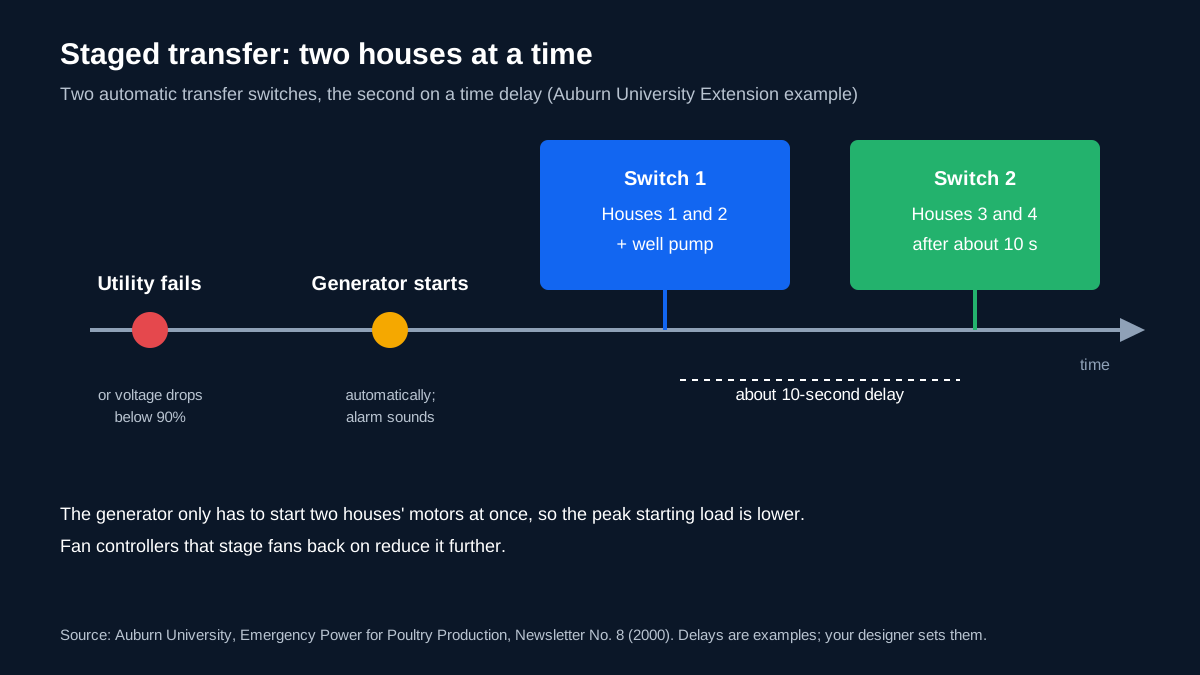
- Transfer on brownout, not only blackout. Auburn recommends setting the transfer switch to move the houses to the generator whenever utility voltage drops below 90 percent, which is 216 volts on a 240-volt service. Motors draw more current at low voltage and can burn out.
- Beat the curtain drops. In houses with automatic curtain drops, generator power should come on before the drops operate, usually about two to three minutes after the outage.
- Alarm on every outage. Transfer to standby should trigger an alarm, and a battery-powered power-loss alarm should sound whether the generator starts or not.
Standby wiring is not a do-it-yourself job. Auburn calls emergency power for commercial poultry "definitely not a do-it-yourself undertaking", puts a fused or main-breaker disconnect on the incoming line ahead of all transfer switches, and tells growers to use qualified professionals. NDSU adds that a generator must never be connected to farm wiring without a double-throw transfer switch that isolates it from the power line. The transfer switch hardware itself (poles, ratings, transition type) is a separate specification for your electrical designer; this guide stays with the sizing consequences.
List the farm loads by group: fans, feeders, water, light, heat and irrigation
Most of a poultry house's electrical load is motors, and a motor that is switched on draws far more current for a few seconds than it needs to keep running. Auburn's figures range from two to twelve times: lightly loaded fans may draw two to four times their running current, while feeder motors starting under load may draw ten to twelve times. North Dakota State University's extension guidance uses a simpler rule for general farm motors, about four times the power to start as to run. The exact multiple depends on the motor, so treat these as planning ranges and use nameplate or supplier data when you have it.
Auburn's 2000 worked example for one broiler house on a hot day, in full tunnel ventilation with evaporative cooling, looks like this:
| Equipment per house (Auburn, 2000) | Running watts | Cold-start watts |
|---|---|---|
| Ten 1-hp tunnel fans | 10,000 | 30,000 |
| Six 3/4-hp feeder motors | 2,010 | 20,100 |
| Two 1-hp water pumps | 2,000 | 6,000 |
| Fifty 75-watt lights | 3,750 | 3,750 |
| Total per house | 17,760 | 59,850 |
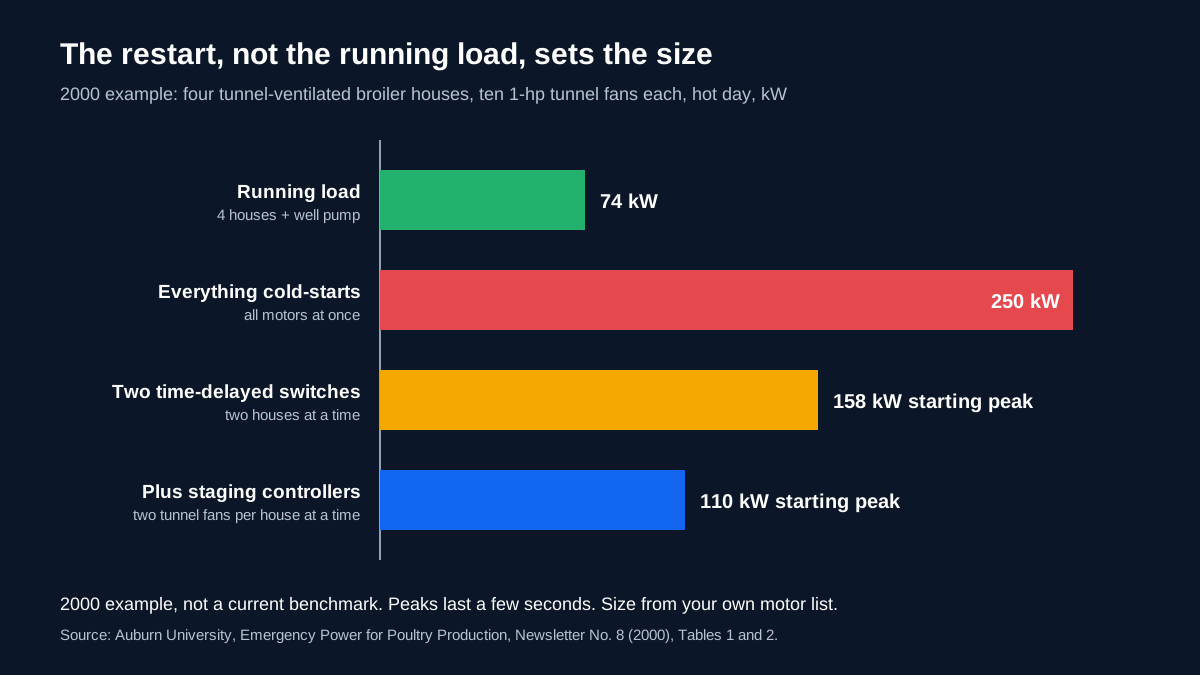
Four houses come to 71,040 running watts, and a 3,000-watt well pump (11,000 watts to start) brings the farm to 74,040 running watts. If every piece of equipment on the farm started from a standstill at the same moment, the cold-start total would be about 250,400 watts. The example numbers are illustrations of the principle, not your farm's figures: same-horsepower motors from different makers can have very different starting and running currents, and long wire runs add to the load.
The example house is also a 2000 house. Alabama Cooperative Extension System publication ANR-2784 (2021), written by National Poultry Technology Center specialists, describes a two-house farm with 66-by-600-foot houses and more than 80 electric motors, including 48 fan motors and 16 feed line auger motors. A house with more or bigger motors than the table needs more generator, so scale from your own counts, not from the per-house total:
- Running watts. Add the nameplate running load of every motor that must run in the outage you are sizing for. Where you only know horsepower, NDSU's guide figure is about 1,000 running watts per horsepower, the same as Auburn's 1-hp fan and pump rows.
- Starting watts. For each motor, use the supplier's starting data if you have it. Otherwise apply the planning multiples: Auburn's table uses three times running watts for fans and water pumps and ten times for loaded feeder motors, and NDSU's general figure is about 4,000 starting watts per horsepower.
- Everything else. Add lights and controls at their running load, the well pump with its own starting load, and the electrical nameplate of every brooder or heater that could run during that outage.
Build your own list the same way, one group at a time:
- Ventilation: tunnel fans, minimum-ventilation fans, inlet and curtain machines, evaporative cooling pumps.
- Feed and water: feeder and auger motors, drinker line pumps, the well pump.
- Lighting and controls: house lights, controllers, alarms.
- Heat: read the electrical nameplate of every brooder, furnace or hot-air heater. A fuel-fired heater may draw only a blower and igniter, while an electric heater is a large load; do not guess.
- Irrigation and other farm loads: irrigation pumps, grain handling, milking and cold rooms.
GENKVA's agricultural generator power page asks for the same separation: list irrigation, ventilation, refrigeration, grain handling, lighting and building loads by season and by what runs during an outage, and give the motor kW, voltage, phase and starting method for the largest pump, compressor or fan. Keep irrigation in its own group. A large irrigation pump can dominate the starting requirement, and if it does not need to run during a summer outage, adding it to the poultry emergency load would buy a much bigger set than the birds need.
Size for the restart, then shrink it with staged transfer
When the utility fails, everything stops. When the generator picks the farm back up, every motor that was running tries to start again. Auburn's 2000 example puts the restart demand at twice the normal running load or more, depending on whether the fans are still windmilling or have come to a stop. If the generator cannot pick up that step it may shut down; worse, it may keep running at low voltage, which drives up motor current and can overheat both the house motors and the generator.
Staging means you usually do not need a generator big enough to start the whole farm at once. Auburn pairs that advice with a warning: the consequences of a generator failing on start-up are very serious, so it highly recommends a conservative approach to sizing. No grower wants to pay for a larger generator than needed, but even more so, nobody wants to pay for one that fails on startup. Auburn describes two ways to shrink the step:
- Time-delayed transfer switches. One generator commonly serves two to eight houses. With two transfer switches, the second set for about a 10-second delay, the farm comes onto the generator two houses at a time instead of four. The well pump belongs in the first block.
- Staging ventilation controllers. Controllers that bring fans back on in stages cut the starting current further. Older controllers and thermostats may latch every piece of equipment ON when power returns, and then the generator has to start everything at once.
In Auburn's four-house example, two transfer switches and non-staging controllers put a maximum starting load of about 158,220 watts on the generator: the running load of the first two houses and the pump, plus the cold start of the second two houses. If the controllers start only two tunnel fans per house at a time, the peak falls to about 110,220 watts. For your own farm, the staged peak is worked out the same way: the running load already on the generator plus the starting load of the block being transferred. NDSU's steps for manually started and tractor-driven generators follow the same logic: start the largest motor first and add other loads as each motor comes up to speed.
For a poultry farm, your controller and transfer-switch staging are part of the generator size, so write them down before anyone quotes a kW figure.
From kW per house to a GENKVA generator class
Auburn's 2000 rule of thumb was that broiler house generator sets with a nameplate of about 25 kW per house often proved adequate, but only with time-delayed transfer switches and staging controllers in place. The same newsletter quoted one Southeast standby-power company's recommendations at the time: 75 kW for two or three houses, 105 kW for four, 125 kW for five or six, and 200 kW for an eight-house broiler complex. Breeder houses were typically higher, commonly 30 to 37 kW per house, and pullet houses lower, around 20 kW per house. Treat these as a historical cross-check on your own motor arithmetic, not a current benchmark. Poultry farm sets are usually rated for standby service, and Auburn noted that the running load is rarely over 75 percent of the standby nameplate. The same source stresses that farms vary and the final size should be set by a qualified engineer or technician, and NC State Extension similarly advises having a licensed electrician determine your power needs.
GENKVA's seven generator classes run from 30 kW (37.5 kVA) to 200 kW (250 kVA) at 0.8 power factor. For the 2000 example farm, the rule of thumb and the equipment company's figure come to 100 to 105 kW of standby nameplate, and Auburn's wiring illustration for a four-house farm uses a 100 kW set. That lands at or just above GENKVA's 100 kW (125 kVA) class; a farm with more or bigger motors lands higher. Auburn's figures are standby nameplate, so confirm whether a quoted class kW is a standby or prime rating before comparing them.
Do not read the 158 kW and 110 kW figures the same way. They are starting peaks that last a few seconds while motors come up to speed, not running loads, so they cannot be compared directly with a class's kW rating. Auburn notes that a high-quality, conservatively rated emergency generator can usually handle brief start-up loads above its nameplate with a slight, brief voltage drop. Whether a particular set can depends on its motor-starting capability and the voltage dip your fans and controllers tolerate, and GENKVA does not publish a motor-starting rating for its classes. Send your motor list and staging plan for a starting-load check instead of assuming a class covers the peak; the method, including locked-rotor kVA, voltage dip and reduced-voltage starters, is covered in generator sizing for motor starting. GENKVA's agriculture guidance sets the same test: the chosen class must carry the normal running combination and tolerate the most demanding motor start. An eight-house farm at the top of the 2000 example range reaches GENKVA's largest 200 kW class, where the complete load study has to confirm that one set is enough rather than a wider engineered or redundant system.
To compare all seven classes side by side, with their engines and typical uses, see GENKVA's generator size guide. Treat any class you pick from a rule of thumb as a starting point for review, not a final selection.
Fuel, runtime and testing between flocks
Runtime on a rural farm is a fuel-logistics question as much as a generator question. Auburn's 2011 newsletter notes that power outages typically last only a few minutes but at times can last for days. Decide how long an outage you are planning for and how quickly a fuel delivery can reach you in bad weather, then size the stored fuel to cover that gap. Alabama Cooperative Extension's generator tune-up checklist asks growers to check the fuel's age, condition and tank fill, and whether they have any backup fuel. GENKVA's agriculture page adds the fuel-type question: diesel gives you portable stored energy, while a natural-gas set needs confirmed gas quality, pressure and flow, and biogas or another non-standard gas needs a composition analysis before anyone assumes it matches an engine.
A generator that exercises itself every week can still fail the farm. Auburn's 2011 newsletter points out that many automatic exercise routines only crank and run the engine without transferring the house load, and that even systems that do transfer it are most often tested in the morning and for only a short time, when not all fans and cooling pads may be running. Its recommendations, alongside the Alabama Extension checklist:
- Exercise the set weekly for at least an hour, actually transferring power and running the farm (Auburn, 2011; its 2000 newsletter gave at least 30 minutes under full load).
- At least once every flock, transfer the farm to the generator with all the equipment that flock needs running, for at least an hour (Auburn, 2011). Between flocks, run a longer load test of several hours (Alabama Extension).
- Test the transfer switches along with the generator weekly, and make sure everyone on the farm can transfer power manually and safely if the automatic control fails.
- Have the generator fully serviced at least once a year.
These tests also check your sizing. If the set struggles to pick up the full summer load with the houses empty, it will not do better with birds inside.
What to send before you ask for a quote
A useful quote request describes the farm, not just a kW number. GENKVA's quote page asks for fuel preference, required kW or kVA, voltage, frequency, phase, power factor, the largest motor or load step, standby or prime duty, expected hours, altitude, temperature, sound requirement and destination, and to label any unknown value as unknown rather than guess. For a poultry or livestock farm, add:
- the number and type of houses (broiler, breeder, pullet or other livestock);
- per house, the count and horsepower of tunnel and minimum-ventilation fans, feeder motors, water pumps and lights, plus the heater nameplates;
- the well pump and any irrigation, grain or milking loads, and whether they must run during an outage;
- whether your controllers stage fans after power returns, and how many transfer switches you plan and with what delay;
- the fuel available on site and the outage duration you want to cover.
That is enough for a first review to identify the nearest confirmed class and the information still missing.
Straight answers
What size generator do I need for a poultry farm?
Size it from your own motor list, not a per-house figure. Auburn University Extension's 2000 rule of thumb was about 25 kW of standby nameplate per broiler house with time-delayed transfer switches and staging fan controllers, for houses like its example with ten 1-hp tunnel fans each; breeder houses were commonly 30 to 37 kW and pullet houses around 20 kW. A 2021 Alabama Cooperative Extension System publication, ANR-2784, describes a two-house farm with 48 fan motors, so a modern house may need more. Add the running load of everything that runs in an outage, check the largest staged starting step, which can be twice the running load or more without staging, and confirm the size with a qualified engineer, technician or electrician.
How fast are birds at risk when the ventilation stops?
Auburn's poultry engineering newsletters say that power failure in an enclosed house can cause massive losses within minutes, and that in hot weather without a standby generator birds will begin dying within minutes. That is why the generator must start and transfer automatically.
Can I use a PTO generator for poultry houses?
Not as the standby source for tunnel-ventilated or totally enclosed houses. Auburn's guidance is that the set must be permanently mounted and controlled by an automatic transfer switch; a tractor PTO alternator or a manual transfer switch will not meet the need.
Why does the generator need more capacity than the running load?
Electric motors draw two to twelve times their running current for a few seconds when they start. After an outage every fan, feeder and pump restarts, and in Auburn's four-house example that step was twice the running load or more unless transfer switches and controllers brought the load on in stages. Because the peak lasts only seconds, it is checked against the generator's motor-starting capability, not its kW rating.
How often should I test a poultry farm generator?
Auburn's 2011 guidance is to exercise the generator weekly for at least an hour, actually transferring power and running the farm, and at least once every flock to transfer the full farm load with that flock's equipment running for at least an hour. Its 2000 newsletter gave 30 minutes as the weekly minimum. Test the transfer switches weekly with the generator and have the set fully serviced at least once a year.
Sources and scope
The sizing arithmetic, per-house figures, transfer settings, timing statements and testing recommendations come from Auburn University's Alabama Poultry Engineering and Economics newsletters No. 1 (1999), No. 8 (2000), No. 18 (2002) and No. 71 (2011), published through the Alabama Cooperative Extension System and the National Poultry Technology Center, and the modern two-house motor count from Alabama Cooperative Extension System publication ANR-2784 (2021). The per-house sizing figures date from 2000, were written mainly for broiler production and explicitly do not cover commercial layer operations; they are examples, not a design for your farm. The motor-start rules of thumb and start-up order come from North Dakota State University Extension, the fuel and between-flock test items from Alabama Cooperative Extension's 2022 tune-up checklist, and the electrician recommendation from NC State Extension. Load groups, fuel notes, generator classes and quote inputs come from GENKVA's own agriculture, product and quote pages. This guide does not describe any GENKVA farm project, customer or certification, and gives no livestock-loss statistic beyond what the sources state.
- Auburn University: Emergency Power for Poultry Production (Newsletter No. 8, 2000)
- Auburn University: Is Your Standby Generator Set to Go? (Newsletter No. 18, 2002)
- Auburn University: Managing Broiler House Backup Systems (Newsletter No. 1, 1999)
- Auburn University NPTC: Avoiding Electrical Catastrophe (Newsletter No. 71, 2011)
- Alabama Cooperative Extension System (NPTC): Start and Run Capacitors for Electric Motors (ANR-2784, 2021)
- NDSU Extension: Standby Electric Generators (updated 2022)
- Alabama Cooperative Extension: 19 Spring Tune-Up Tips for Poultry Farm Generators (2022)
- NC State Extension: Purchasing a Back-Up Generator for the Farm (2014)
Planning backup power for your poultry houses?
Send GENKVA your house count, fan, feeder and pump list, transfer-switch staging and fuel details, and the factory will review which generator class fits.
Request a generator quote