
kVA, kW and the 0.8 power factor GENKVA uses
Generator output gets quoted two ways: kVA (apparent power) and kW (real power, what your equipment actually consumes). GENKVA's published ratings pair the two at a 0.8 power factor, the reference figure conventionally used across generator-set specifications industry-wide — so every model page shows both a kVA number and a kW number for the same physical unit, not two different products.
If your facility's load list is expressed in kW, read the kW column below. If it's in kVA, read the kVA column. If you're not sure which figure you have, or you want a more precise conversion than a table lookup, the kW/kVA calculator and generator size calculator handle the arithmetic directly.
Compare all 7 GENKVA generator tiers
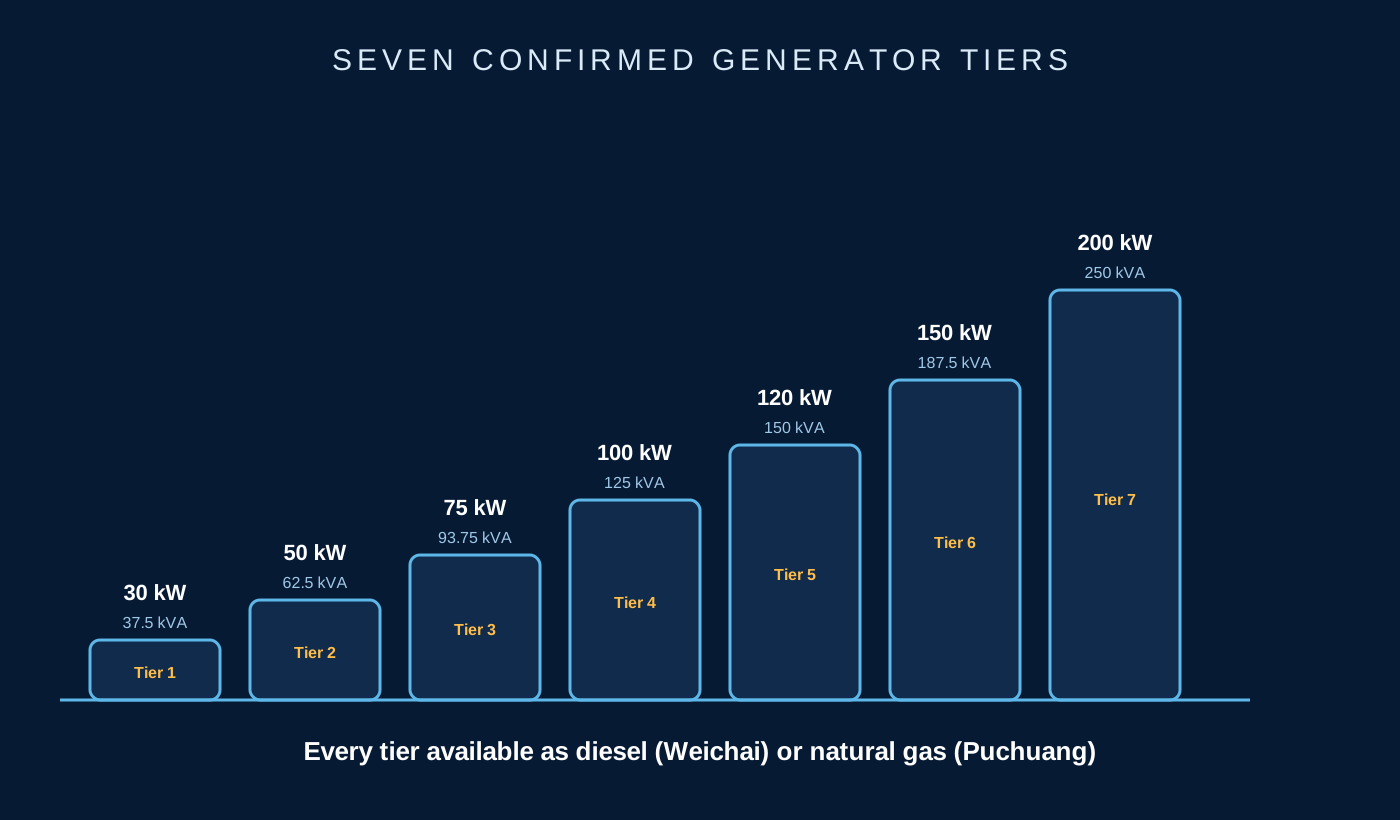
| kW | kVA | Diesel engine (Weichai) | Natural-gas engine (Puchuang) | Model page |
|---|---|---|---|---|
| 30 kW | 37.5 kVA | WP2.3D40E200 | PC4B3.9 | 30kW generator |
| 50 kW | 62.5 kVA | WP4.1D66E200 | PC6B5.9 | 50kW generator |
| 75 kW | 93.75 kVA | WP4.1D113E200 | PC6BTAA5.9 | 75kW generator |
| 100 kW | 125 kVA | WP6D132E200 | PC6CTAA8.3 | 100kW generator |
| 120 kW | 150 kVA | WP6D152E200 | PC6CTAA8.3 | 120kW generator |
| 150 kW | 187.5 kVA | WP10D200E200 | PC6LTAA8.9 | 150kW generator |
| 200 kW | 250 kVA | WP10D264E200 | PC6LTAA9.5 | 200kW generator |
Every tier is offered as either version — fuel type is a separate decision from size. A diesel set gives you flexible fuel storage and delivery; a natural-gas set needs suitable gas pressure, flow and composition at the site. Pick the row closest to your load, then open that model page for the full configuration.
Match your load to a tier
These are planning starting points based on what GENKVA typically sees at each output level — not a guaranteed application match. The exact configuration still depends on your electrical output, operating duty, transient loads and site conditions, which is why every tier's page asks for that data before quotation.
| Tier | Buyers commonly investigate this output for | Watch for |
|---|---|---|
| 30 kW / 37.5 kVA | Small site offices, lighting, compact pumps, telecom shelters, select farm loads | One direct-on-line motor can dominate this class — provide its starting-current data |
| 50 kW / 62.5 kVA | Small commercial backup groups, irrigation pumps, workshops, construction support loads | Confirm which pump, compressor or cooling load starts first after transfer |
| 75 kW / 93.75 kVA | Larger site services, agricultural systems, small production groups, multi-load commercial backup | Separate the normal running combination from the largest motor or transformer step |
| 100 kW / 125 kVA | Commercial facilities, industrial utilities, larger pumps, coordinated groups of essential circuits | Provide the reconnection sequence — simultaneous starts can exceed the steady-load estimate |
| 120 kW / 150 kVA | Motor-rich workshops, production support, larger farm systems, facility standby groups | State harmonic loads, drive types and acceptable voltage dip for sensitive controls |
| 150 kW / 187.5 kVA | Industrial support systems, mining utilities, larger commercial standby groups, remote operations | Daily operating hours and minimum load matter if this class is considered for prime duty |
| 200 kW / 250 kVA | The largest confirmed GENKVA projects — coordinated industrial, infrastructure and remote-site loads | Verify the complete load study fits one set and doesn't need a wider engineered or redundant system |
If your load sits between two tiers, the next size up is the safer starting point for a quote conversation — GENKVA's team reviews the actual load data before confirming a configuration either way.
Three factors that can push you up a tier
A tier match on running load alone can still be wrong. Three factors regularly move a buyer to the next size up, and each already has its own dedicated review on this site — this guide points to them rather than repeating them:
- Motor starting surge. If your load includes motors, pumps or compressors that start under load, the inrush current at startup can exceed what the running-load figure alone suggests. See generator sizing for motor starting for how to size around it.
- Altitude and temperature. A generator's usable output at your site can be lower than its nameplate rating depending on elevation and ambient temperature. See generator derating for altitude and temperature before finalizing a tier.
- Duty rating. Standby, prime and continuous ratings apply to different run patterns, and the same physical unit can carry a different usable rating depending on which duty applies to your project. See standby vs. prime vs. continuous generator ratings to confirm which one fits.
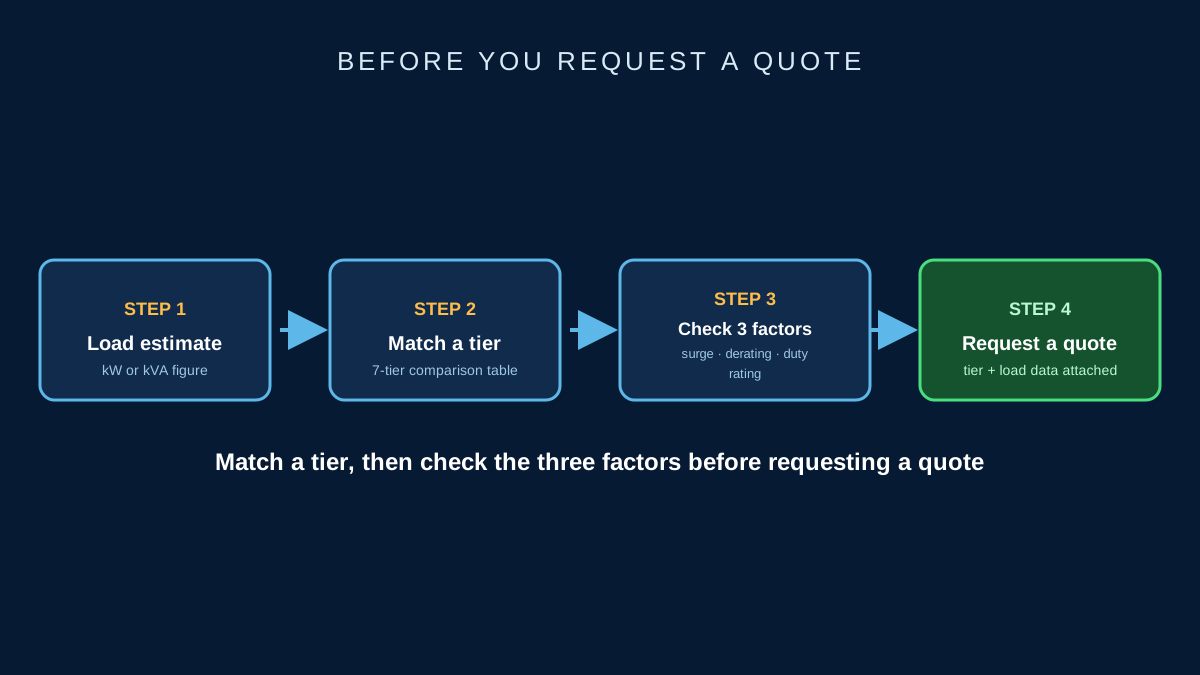
None of these three factors is optional to check — they're just outside this article's scope, because each already has a more thorough answer elsewhere on this site.
Straight answers
Does GENKVA offer generators smaller than 30 kW or larger than 200 kW?
The seven tiers below — 30 through 200 kW (37.5 through 250 kVA) — are GENKVA's current confirmed range. If your project falls outside that range, raise it directly in a quote request rather than assuming an unlisted configuration exists.
What's the difference between the kVA and kW figures on GENKVA's model pages?
They describe the same physical generator set. kW is the real power your equipment consumes; kVA is the apparent power rating, calculated from kW at a 0.8 power factor. Both numbers are shown for every tier so you can match whichever figure your own load list uses.
Can I get any GENKVA tier as either diesel or natural gas?
Yes. Every one of the seven tiers is available as a Weichai-engine diesel set or a Puchuang-engine natural-gas set. Fuel type and size are independent decisions.
Is the tier I pick from this table my final generator size?
Treat it as a starting point for your quote conversation, not a final selection. Motor starting surge, altitude/temperature derating and duty rating can each move you to the next tier up — check the three linked articles above, then confirm with GENKVA's team using your actual load data.
What information should I send with a quote request?
Your running load (in kW or kVA), the candidate tier from the table above, whether you want diesel or natural gas, and any site conditions you already know — altitude, ambient temperature, and the expected run pattern (standby, prime or continuous).
Sources and scope
Tier specifications (kVA, kW, diesel and gas engine models) and the per-tier typical-use guidance come directly from GENKVA's current confirmed product data. The kVA/kW/0.8-power-factor pairing reflects the same convention used across GENKVA's own published specifications. This guide is a planning starting point for narrowing to a candidate tier — final configuration always depends on your specific load data, site conditions and duty pattern, reviewed by GENKVA's team at quotation.
Ready to compare tiers against your own load?
Prepare a quote with your load data attached
Have your running-load estimate, candidate tier and fuel preference ready when you request a generator quote. Include site conditions if you know them — it gives the review a clear starting point.
Request a generator quote