
Why telecom sites don't size like a commercial building
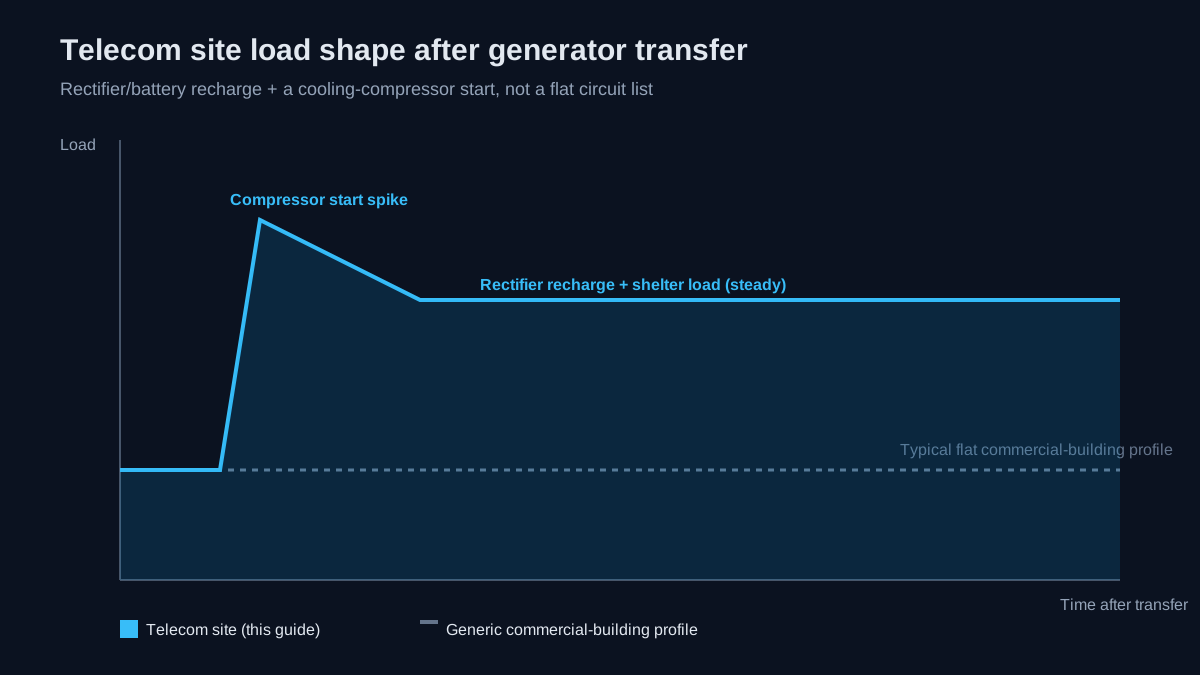
Most commercial standby sizing starts from a circuit-by-circuit load schedule: lighting, HVAC, elevators, life-safety loads. A telecom site's load schedule looks different. The largest steady draw is usually the rectifier system charging the DC plant and batteries, not a single dominant circuit. On top of that steady draw sits one recurring transient: the shelter or cabinet's air-conditioning compressor cycling on and off, especially right after a long outage when the equipment has been running warm on battery power. GENKVA's own telecom application guidance frames this directly -- review AC-side rectifier input, cooling-system starts, and remote-site fuel autonomy together, because DC output alone doesn't show the generator-side requirement.
That combination -- a steady base load plus a recurring motor start, usually on standby duty, usually at a site with limited or no on-call maintenance staff -- is the reason a telecom backup generator decision needs its own checklist rather than reusing a general commercial-building sizing pass.
What to add up before you pick a size
Four categories of load data typically matter for a telecom site:
- Rectifier and battery-charging demand. Get the rectifier system's AC input rating, power factor, and -- where available -- harmonic content, not just its DC output rating. A rectifier recharging depleted batteries after an outage can draw meaningfully more than its steady-state trickle-charge figure.
- Cooling load, including the compressor start. Shelter or cabinet air conditioning is usually the one motor-starting event on a telecom site. If that compressor starts under load right after transfer, its inrush current needs the same kind of check any motor-starting load does -- see generator sizing for motor starting for how to gather that evidence (locked-rotor current, starting method, what else is running at the same moment) rather than assuming a generic multiple of running current.
- Other shelter circuits. Lighting, alarm/monitoring equipment, and any auxiliary loads specific to the cabinet or shelter.
- The post-outage condition, not just steady state. In the first minutes after transfer, the generator may be asked to carry rectifier recharge current, a cooling-system start, and normal shelter load at the same time. Sizing only from steady-state numbers can understate that first-minutes peak.
None of this replaces a real load study. It's the input list a telecom-site quote request needs before a configuration review can start.
Runtime and autonomy: treat published minimums as a floor, not a target
Backup-power industry sources commonly cite an eight-hour minimum runtime expectation for U.S. cell sites, a figure that traces back to FCC guidance issued after Hurricane Katrina exposed how quickly unstaffed sites lost service during extended outages. That eight-hour figure is a widely referenced floor, not a universal design target -- sites in hurricane-, wildfire-, or flood-exposed areas, or sites serving public-safety and 911 traffic, are routinely planned for materially longer autonomy, and remote or hard-to-access tower sites may need days rather than hours of stored fuel simply because a delivery truck can't reliably reach them on short notice.
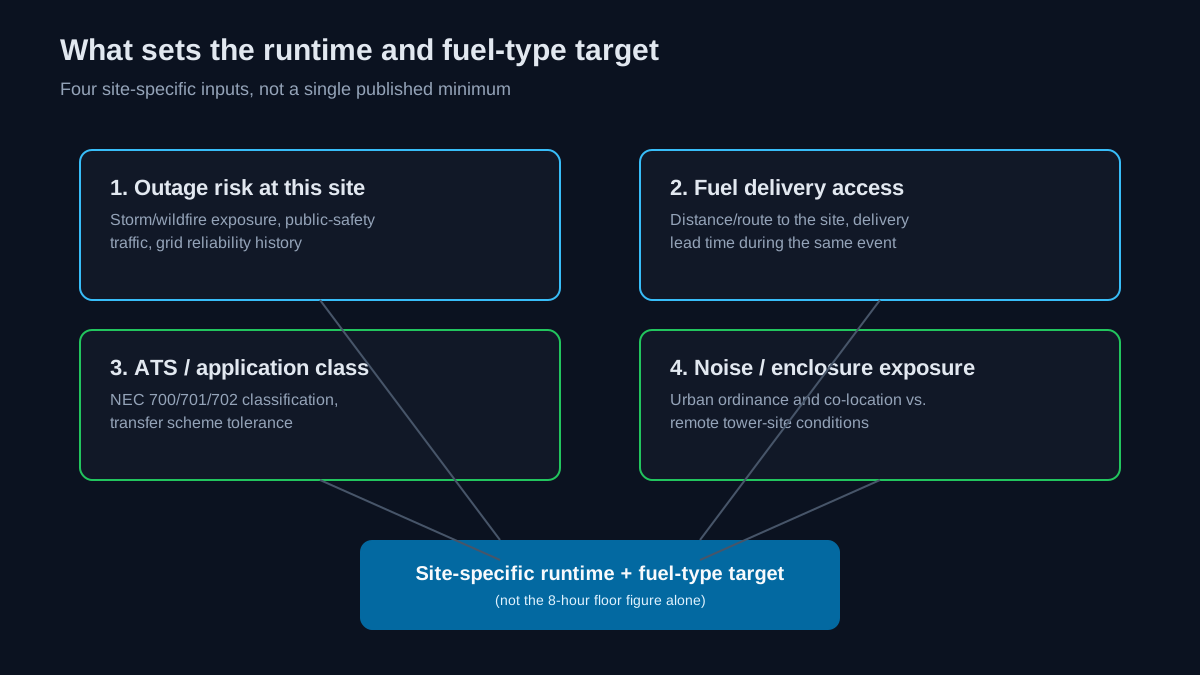
Two separate questions determine what autonomy target actually fits a given site: how long is the credible outage this site needs to survive, and how quickly can fuel realistically be delivered if the generator runs out. A site 20 minutes from a fuel depot and a site at the end of an unpaved mountain road need different answers even at the same load. Exact liters-per-hour consumption math for a specific GENKVA configuration is outside this guide's scope -- that calculation depends on the exact engine, load profile and manufacturer fuel curve for the model under review, and should be built the same way any generator fuel-and-tank plan is built: from the selected unit's own data, not a rule of thumb.
Fuel type: diesel's stored-energy independence is why it dominates remote telecom sites
Diesel remains the default fuel choice for unattended and remote telecom sites for a specific reason: the fuel is stored on-site and doesn't depend on a live utility connection (a gas line) staying intact during the same storm or grid event that took down commercial power in the first place. That independence matters more at a remote tower site with no realistic fallback than it does at a site with a documented, reliable gas supply.
Natural gas is a reasonable alternative only where that supply is actually verified -- confirmed pressure, flow and reliability at the specific site, not an assumption that "gas is available nearby." GENKVA's telecom application guidance is explicit on this point: natural gas is considered only where a stable supply is documented, and diesel remains the practical comparison for many isolated tower sites. GENKVA builds both diesel (Weichai engine) and natural-gas (Puchuang engine) configurations across its published capacity range -- see the full model comparison -- so the fuel-type decision for a telecom site is a site-conditions question, not a capacity limitation.
ATS and transfer behavior for telecom-critical loads
An automatic transfer switch (ATS) is what actually connects the generator to the telecom load once utility power is confirmed lost, and its behavior matters as much as the generator's rating. Three things worth confirming with any telecom-site ATS specification:
- It's rated for the actual load, not just "big enough." ATS units are rated in amperes against the protected panel's service size, and UL 1008 is the listing standard commonly specified for this application class.
- Its application class is documented. NEC Article 700 (emergency/life-safety), 701 (legally required standby) and 702 (optional standby) describe different transfer-switch application classes with different requirements. Which one applies depends on whether the telecom load in question is classified as life-safety-adjacent (for example, a site carrying 911 or public-safety traffic) or ordinary optional standby -- that classification is a project-specific determination, not something this guide can assign generically.
- The transfer sequence matches what the rectifier and batteries can tolerate. A DC plant recharging batteries is sensitive to how cleanly power is re-established after transfer. Confirm the transfer scheme (and any start-signal or monitoring-interface requirements) with your controls provider -- this belongs to the telecom system design, not the generator selection alone, a boundary GENKVA's own telecom application guidance draws explicitly.
For the broader distinction between standby, prime and continuous generator ratings -- which duty classification a telecom backup unit actually needs, and why that classification affects what capacity is usable -- see standby vs. prime vs. continuous generator ratings. Most telecom backup generators are standby-duty units sized for defined outage events behind a battery/rectifier plant, not prime- or continuous-duty units carrying the load directly; confirm which classification your project actually needs before finalizing a size.
Noise, enclosure and permitting: tower sites and urban sites need different answers
A rural tower-site generator and a rooftop or in-building urban telecom generator face different constraints, even at the same electrical rating:
- Urban and co-location sites more often need a sound-attenuated enclosure to meet a local noise ordinance or a shared-building agreement, and a containerized or weatherproof enclosure rated for the installation's actual exposure (a rooftop is not the same exposure as a ground-level pad).
- Remote tower sites more often prioritize a ruggedized enclosure for temperature extremes, extended fuel-tank capacity, and remote-monitoring integration over acoustic treatment, since there's typically no adjacent occupied space to protect from noise.
- Permitting and code requirements vary by jurisdiction and by whether the site is classified as carrying life-safety traffic (see the ATS application-class point above). This guide can't state a specific noise limit, setback distance or permit requirement that applies universally -- that has to come from the local authority having jurisdiction and the site's own zoning and permitting review, not from generic guidance.
Treat noise and enclosure requirements as a site-specific input to gather early, alongside the load data above, rather than a detail to resolve after a capacity is already chosen.
Straight answers
Is a telecom backup generator sized the same way as a commercial building's standby generator?
No. A telecom site's load is dominated by rectifier/battery-charging demand plus one recurring motor-starting event (the cooling-system compressor), and it's almost always standby duty behind a battery/rectifier plant rather than an engineered commercial redundancy scheme. Use the telecom-specific load inputs in this guide, not a generic commercial-building sizing pass.
How many hours of runtime does a telecom backup generator need?
An eight-hour minimum is a commonly cited industry floor tracing back to post-Katrina FCC guidance for U.S. cell sites, not a universal design target. Sites in disaster-exposed areas, sites carrying public-safety traffic, and remote sites with unreliable fuel-delivery access are routinely planned for materially longer autonomy. Set the target from the site's actual outage risk and delivery access, not the floor figure alone.
Should a telecom site use a diesel or natural-gas generator?
Diesel is the default for remote and unattended sites because the fuel is stored on-site and doesn't depend on a live gas connection surviving the same event that took down utility power. Natural gas is a reasonable option only where a stable, documented supply exists at that specific site. GENKVA builds both configurations across its published capacity range.
Does the ATS matter as much as the generator's kW/kVA rating?
Yes. The ATS has to be rated for the actual protected load, carry the correct application-class listing (NEC 700/701/702, commonly under a UL 1008 switch listing) for whether the site carries life-safety-adjacent traffic, and use a transfer sequence the rectifier and batteries can tolerate. Confirm all three with your controls provider alongside the generator sizing.
Do tower sites and urban telecom sites need the same enclosure?
No. Urban and co-location sites more often need sound-attenuated, code-compliant enclosures to satisfy a local noise ordinance or building agreement. Remote tower sites more often prioritize ruggedized enclosures, extended fuel tanks, and remote monitoring over acoustic treatment. Permitting requirements vary by jurisdiction -- confirm locally rather than assuming a generic answer applies.
What should I send GENKVA with a telecom generator quote request?
Rectifier AC-input rating and power factor, cooling-system compressor starting data, other shelter circuit loads, the outage duration and fuel-delivery access you're planning around, your fuel-type preference (with supply documentation if natural gas), and any known site constraints -- noise ordinance, enclosure exposure, and ATS application class if already determined.
Sources and scope
The rectifier/cooling/autonomy/controls framing in this guide reflects GENKVA's own published telecom application guidance. The eight-hour runtime-floor figure and its post-Katrina FCC origin, the diesel-independence rationale, and the ATS application-class (NEC 700/701/702, UL 1008) framing are drawn from the third-party industry sources listed below; treat all runtime, autonomy and code-classification figures here as general industry guidance to verify against your own site's regulatory jurisdiction and load study, not as a GENKVA-specific commitment or a substitute for an engineer's determination. This guide does not restate the standby/prime/continuous duty definitions or the motor-starting inrush methodology -- it applies both to the telecom-specific load shape rather than re-deriving them.
- GENKVA -- Telecom Backup Generator Power application guidance
- Generator Source -- Cell Phone Towers Use Standby Power Generators for Communications Backup
- Fuel Logic -- Cell Tower Backup Power for Reliable Uptime
- Generac Industrial -- Generators for Telecommunications Backup
- PowerGen Enterprises -- Automatic Transfer Switch (ATS) Buyer's Guide
Ready to size a telecom backup generator?
Send GENKVA your rectifier and cooling load data, target autonomy, fuel-type preference and any known site constraints for a configuration review.
Request a generator quote