
Your schedule runs on two clocks: the calendar and the hour meter
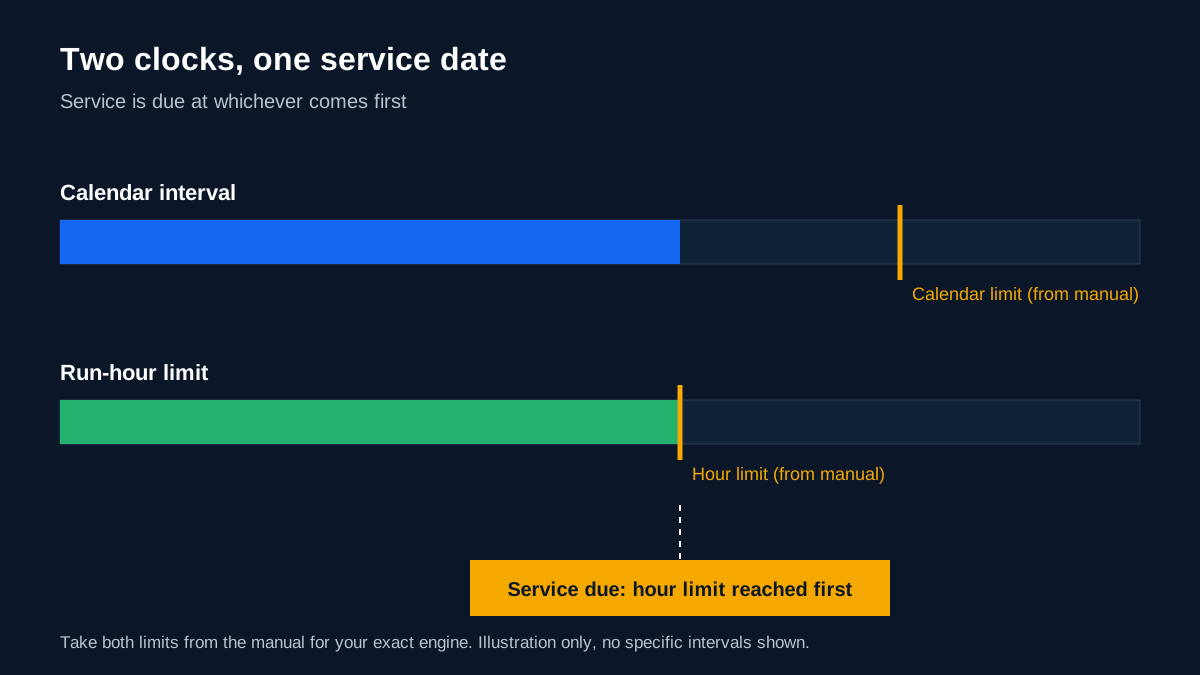
Most generic checklists are written as a calendar: do this weekly, that monthly, the rest once a year. Engine manufacturers write service intervals differently. Many service items carry a calendar interval and a run-hour limit side by side, and the job is due at whichever one the engine reaches first. A standby set that runs only for monthly exercise will hit the calendar limit long before the hour limit. A set that carried a week-long outage, or that works as prime power on a remote site, can burn through the hour limit in a single season.
The numbers also change from model to model, which is why a copied checklist is a weak substitute for the manual. One Cummins Onan maintenance sheet (F-1576) lists the oil and filter change at "Yearly, 200 Hrs" for some models and "Yearly, 350 Hrs" for others in the same product family. Some items on the same sheet run on one clock only: valve-lash adjustment is listed by hours alone for some models, and the coolant change by years alone. Those are not figures for your engine. They are a reminder that the controlling numbers live in the documentation for the exact engine you own.
GENKVA's diesel generator maintenance resource names the confirmed model manual and the agreed service schedule as the controlling instruction. GENKVA's diesel generator sets use Weichai WP-series engines, so for a GENKVA set the limits for oil, filters, valve adjustment and coolant come from the WP engine manual that matches the engine code on your nameplate. Write both limits into your schedule and track engine hours at every check. Tracking hours is the only way to see that the second clock has overtaken the first.
Weekly inspection and monthly exercise: what NFPA 110 actually asks
NFPA 110, the Standard for Emergency and Standby Power Systems, sets the inspection, exercise and testing rhythm for Level 1 and Level 2 emergency power supply systems wherever it has been adopted. If your generator is optional standby and no authority requires NFPA 110, it is still a sensible benchmark. The wording below is taken from NFPA's own revision-cycle records for the standard. Check it against the edition your authority having jurisdiction enforces before you treat it as your compliance baseline.
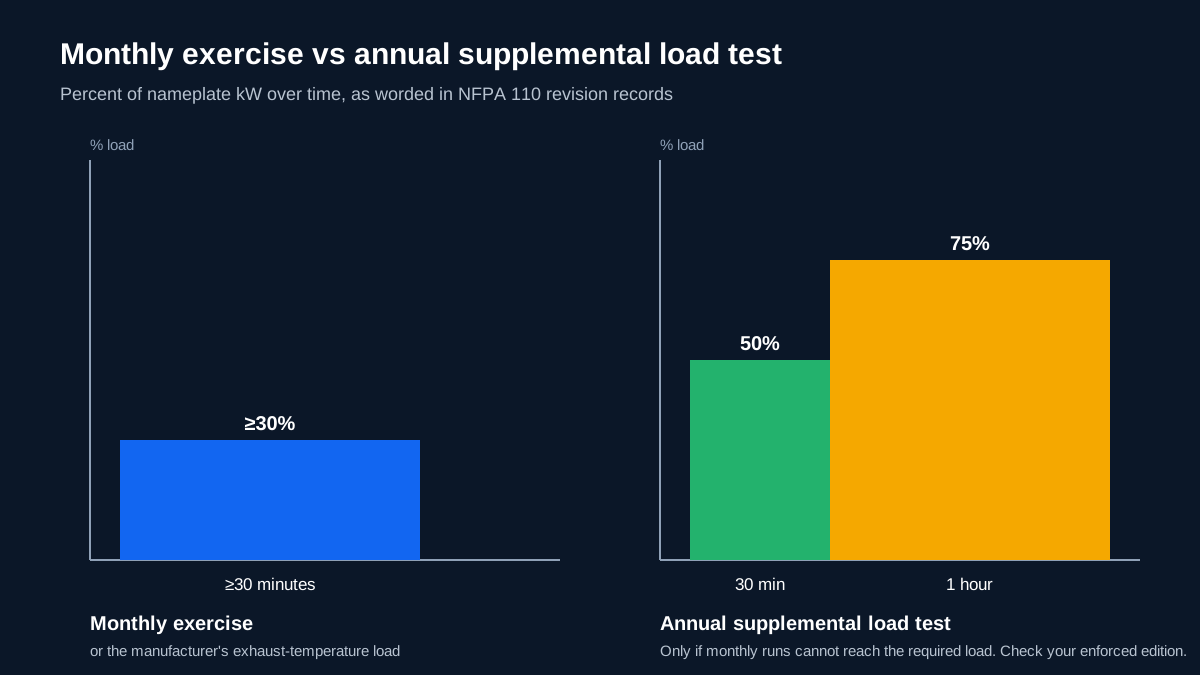
The emergency power supply is inspected weekly and exercised under load at least monthly. For a diesel set, the monthly run lasts at least 30 minutes and uses one of two methods:
- a load that holds the minimum exhaust gas temperature recommended by the engine manufacturer, or
- at operating temperature, not less than 30 percent of the standby nameplate kW rating.
A supplemental load bank may be used to reach the 30 percent. The standard's revision records for the 2025 edition also show the committee proposing a lighter monthly visual inspection for Level 2 systems, with Level 2 battery inspection moving from weekly to monthly. Confirm which level your system is and what your edition says.
Two more items belong on an NFPA 110 schedule. Transfer switches are operated monthly, electrically moving from the primary position to the alternate position and back. A Level 1 system is also tested at least once every 36 months for the duration of its assigned class; where the class is longer than 4 hours, the test may stop after 4 continuous hours, and it may be combined with a monthly exercise and the annual supplemental test. If the set carries a real outage or runs for peak load shaving, that use may count toward scheduled testing, provided it is recorded the same way as a test.
The reason for the load requirement is wet stacking. According to NFPA 110's explanatory notes, light loading leaves unburned fuel or carbon, or both, in the exhaust system, and continuous black smoke during engine running readily indicates it. A weekly start with no load confirms that the engine cranks and the controller responds, but it does not replace a loaded monthly run. One dealer checklist keeps that weekly start to several minutes; follow your engine manufacturer's guidance on no-load running. GENKVA's resource page also notes that no-load exercise confirms only part of the system.
Calculate the 30 percent from the right number. The notes give an example: a 100 kW standby generator is normally considered an 80 kW set for prime power, so 30 percent is 30 kW on the standby nameplate but only 24 kW if you work from the prime figure by mistake. If you are unsure which rating on your nameplate is which, see standby, prime and continuous ratings, and keep a permanent record of the rating you used.
The annual load test is triggered by light monthly loading
A lot of published checklists put "annual load bank test" on the list with a fixed recipe, and some describe it as a two-hour run at full load. NFPA 110 frames it differently. The annual supplemental test applies to a diesel installation that cannot meet the monthly loading requirement. In that case the set is exercised monthly with whatever building load is available, and once a year it is run with supplemental load:
- not less than 50 percent of the nameplate kW rating for 30 continuous minutes, then
- not less than 75 percent of the nameplate kW rating for 1 continuous hour,
for a total test of at least 1.5 continuous hours. If your monthly exercise already reaches 30 percent of the standby nameplate (or the manufacturer's exhaust-temperature load), NFPA 110 does not require this annual supplemental test, although your authority, insurer or service contract may still ask for periodic load testing.
Keep this in-service test separate from the factory acceptance test. A factory load bank test before shipment proves the configuration that left the factory. The monthly and annual runs described here prove that the installed set is still healthy under load in its own site conditions.
Batteries, cooling and lubrication: the checks that decide whether it starts
A standby generator that runs perfectly under load is useless if it cannot crank. NFPA 110 calls for the starting and control batteries to be inspected weekly, checking electrolyte levels or battery voltage, and maintained to the manufacturer's recommendations. It also calls for monthly battery testing: lead-acid batteries have their electrolyte specific gravity tested and recorded every month, with conductance testing permitted instead, and the 2025-cycle revision records extend monthly testing to maintenance-free batteries by conductance, ohmic, carbon-pile or cranking-voltage-drop testing. Plan replacement instead of waiting for a failed start. The standard's explanatory notes recommend replacing lead-acid starting batteries when semiannual internal ohmic testing indicates it. Without that testing, the notes suggest replacement every 24 to 30 months where batteries sit above 27 °C (about 81 °F) for significant periods, and every 36 to 60 months in cooler conditions. Put the install date on the battery and in the log.
For cooling and lubrication, dealer service checklists start with a daily look at the oil and coolant levels and a walkaround for leaks, then add belts and hoses monthly, and change the oil and filter once a year unless the manufacturer's hour limit arrives first. The table below lays out the full set of tiers. Dusty or hot sites may need these checks more often, as GENKVA's resource page notes, so treat the table as a starting grid and tighten it to your manual and site.
A printable diesel generator maintenance schedule
The table separates three kinds of work that are often mixed together: operator checks, exercise and testing, and service tasks set by the engine manual. Print it, add your engine's hour limits in the last row, and keep it with the log.
| Interval | Operator checks | Exercise and testing | Service by manual |
|---|---|---|---|
| Daily / before start | Walkaround for leaks and obstructions; oil and coolant level; fuel gauge; charger status | -- | -- |
| Weekly | Inspect the set (NFPA 110 weekly inspection); battery electrolyte or voltage; brief start of several minutes, listening for abnormal vibration, smoke or noise | -- | -- |
| Monthly | Belts, hoses, battery terminals, charger output; battery test (specific gravity or conductance, per battery type) | At least 30 minutes at ≥30% of standby nameplate kW or at the manufacturer's exhaust-temperature load; operate the transfer switch | -- |
| Every 6 months | Air filter, exhaust system, drive belts | Ohmic battery test if you use the replacement-by-test approach | -- |
| Annually | Review the log and trends | Supplemental load test (50% for 30 min, then 75% for 1 h) if monthly runs cannot reach the required load | Oil and filter change unless the hour limit comes first; other items per manual |
| Every 36 months (Level 1) | -- | Test under load (for diesel, at least 30% of nameplate kW or the manufacturer's exhaust-temperature load; minimum per your edition) for the system's assigned class duration (may stop after 4 h; may be combined with a monthly and the annual test) | -- |
| By run hours | Record hours at every check; log outage runs | -- | Oil, filters, valve adjustment and coolant at the limits in your engine manual (the Weichai WP manual for GENKVA sets) |
The NFPA 110 cells (weekly inspection, monthly battery test, monthly exercise and transfer-switch operation, the annual supplemental test and the Level 1 36-month test) apply where the standard is adopted; the rest reflects common dealer practice. Where your engine manual is stricter, the manual wins.
Record every check, then order parts with the right identification
A schedule only works if the record shows what happened. GENKVA's maintenance resource suggests one log that captures the date, engine hours, starts, alarms, leaks, fluid levels, battery readings and corrective work, plus the exact filters, fluids and parts installed. A trend across several months tells you far more than a single reading, and the parts record tells the next technician what changed.
When a scheduled service comes due, the same record makes the parts order straightforward. GENKVA's spare parts inquiry page asks for the generator rating, fuel type, engine model, alternator and controller models, clear nameplate photographs and every marking on the part. It also asks whether the request is for scheduled maintenance. GENKVA reviews that evidence and confirms compatibility in writing before an order is placed, so do not buy a look-alike filter from a photo.
Straight answers
How often should a diesel generator be serviced?
At whichever comes first of the calendar interval and the run-hour limit in your engine manual. Dealer checklists commonly put the oil and filter change at once a year for a lightly used standby set unless the hour limit arrives first, with operator checks daily or weekly, monthly and every six months. The manual for your exact engine sets the hour limits.
Does a weekly no-load run count as exercising the generator?
Not as NFPA 110 describes exercise. The standard asks for a monthly run of at least 30 minutes, either at a load that holds the manufacturer's minimum exhaust gas temperature or at not less than 30 percent of the standby nameplate kW. Running at light load leads to wet stacking: unburned fuel or carbon in the exhaust, readily indicated by continuous black smoke.
What annual load bank test does NFPA 110 call for?
For a diesel set that cannot meet the monthly loading requirement, an annual supplemental load test of at least 50 percent of nameplate kW for 30 continuous minutes followed by at least 75 percent for 1 continuous hour, 1.5 hours in total. Confirm the steps against the edition your authority enforces.
How often should a generator starting battery be replaced?
NFPA 110's explanatory notes recommend replacing lead-acid starting batteries when semiannual ohmic testing indicates it. Without that testing, the notes suggest every 24 to 30 months in hot conditions (above about 81 °F for significant periods) and every 36 to 60 months in cooler conditions. In the meantime, inspect them weekly and, where NFPA 110 applies, test them monthly.
What should I send GENKVA when I need filters or other parts?
The generator rating and fuel type, the engine, alternator and controller models, clear nameplate photographs, the markings on the part, the quantity, and a note that the request is for scheduled maintenance. GENKVA reviews the evidence and confirms compatibility in writing before an order is placed.
Sources and scope
The exercise, inspection, transfer-switch, 36-month test, wet-stacking, 30 percent, battery-testing and battery-replacement statements come from NFPA 110 text as recorded in NFPA's revision-cycle documents for the 2022 and 2025 editions. Those records are not the purchased standard, so confirm every requirement against the edition your authority having jurisdiction enforces. The whichever-first example comes from a Cummins Onan maintenance sheet for marine models and is an illustration only. The operator-check tiers reflect published dealer checklists from Depco Power Systems and Thompson Power Systems. Record fields and the parts-request details come from GENKVA's own maintenance and spare-parts pages. This guide gives no hour interval for any Weichai or GENKVA engine and makes no warranty or service commitment; use your engine manual and qualified service personnel. Fuel storage and fuel quality management, and natural-gas generator maintenance, are outside the scope of this guide.
- NFPA 110 First Draft revision statements (2022 edition cycle)
- NFPA 110 public input responses (2022 edition cycle)
- NFPA 110 First Draft revision statements (2025 edition cycle)
- Cummins Onan F-1576 maintenance and parts sheet
- Depco Power Systems -- Diesel Generator Maintenance Checklist
- Thompson Power Systems -- Maintaining Diesel Generators
Ordering parts for a scheduled service?
Send GENKVA your generator rating, engine model, nameplate photos and part markings, and note that the request is for scheduled maintenance.
Send a spare parts inquiry