
Why a commercial building doesn't size like a telecom site or a factory
An office, retail or light-industrial building's standby load isn't one number -- it's a set of circuits with different priority levels. GENKVA's own commercial standby power guidance frames this directly: review lighting, lifts where applicable, refrigeration, security, communications, pumps and selected HVAC circuits, then decide whether the generator needs to support life-safety systems, business continuity, refrigeration, selected comfort loads, or the whole building. That's a different starting question than a telecom site's rectifier/battery-recharge-plus-one-motor-start profile (see the telecom backup generator guide if that's the site type you're actually planning for) or a factory's sustained process load.
The practical implication: before you can size anything, you need a clear statement of which circuits must stay on, which can wait, and which can be shed entirely during an outage -- not an assumption that the whole building needs to run. If lifts, pumps or HVAC compressors are part of your load, see generator sizing for motor starting for how to gather the inrush-current evidence those loads require.
Load shedding: the fastest way to right-size a commercial generator
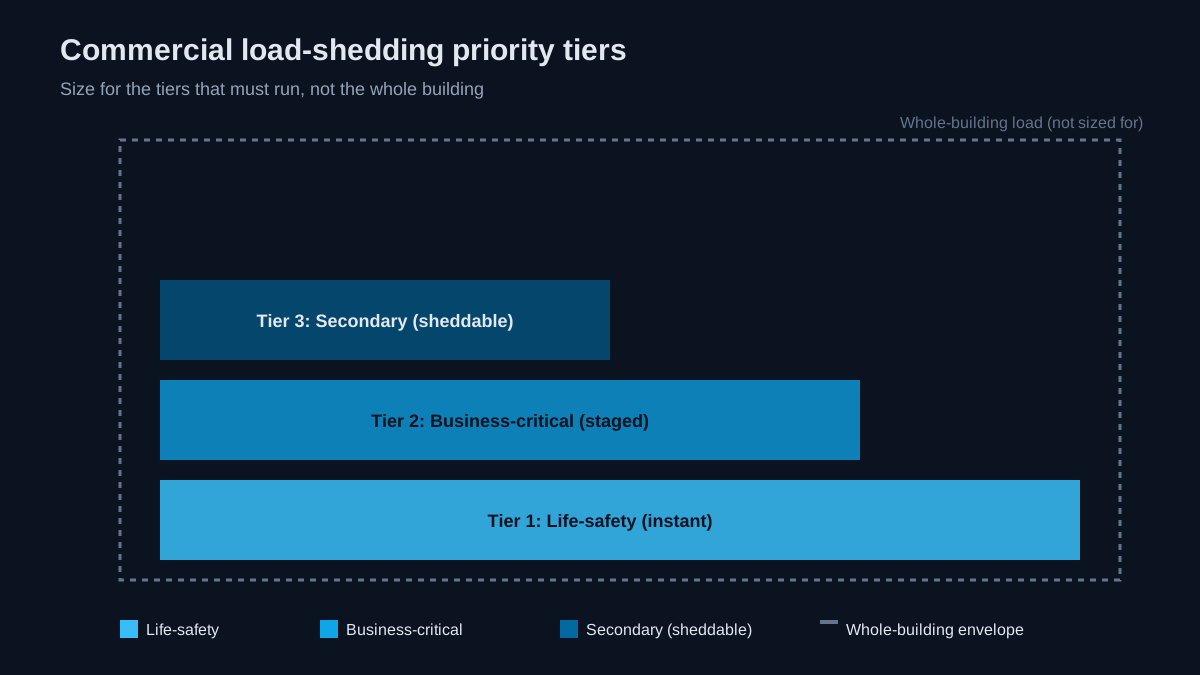
Grouping commercial circuits into priority tiers is the single biggest lever for reducing generator size, fuel volume, footprint and noise output. A commonly used framework has three tiers:
- Life-safety / legally required. Emergency lighting, fire alarms, smoke control, fire pumps, and egress and life-safety communications -- these transfer without delay and are rarely candidates for shedding.
- Business-critical. Refrigeration, point-of-sale systems, security and access control, servers, and selected process equipment -- loads that keep the business functioning, even if not every comfort system is running.
- Secondary / sheddable. General HVAC, elevators, and ordinary receptacle circuits -- loads that can be shed entirely or staged back in once the priority tiers are stable.
Turning off secondary loads lets the generator be sized for the primary and business-critical tiers only, rather than the whole building -- which typically means less fuel, less installation space, and a smaller footprint. This is a general industry load-management framework, not a code-mandated categorization scheme; your own legal requirements (life-safety systems specifically) and business priorities determine which of your circuits actually belong in each tier. GENKVA's own guidance puts it plainly: mark loads that may be shed, because a clear service-level decision prevents an expensive whole-building assumption from replacing a useful critical-load plan.
Runtime and autonomy: treat the default tank class as a floor, not a target
Most standby generator sets under 1,000 kW ship on a double-wall UL 142 sub-base fuel tank sized under common NFPA 110 Class designations -- Class 2, 6, 48 and 96 are the typical designations, roughly corresponding to a 2-to-96-hour range, with most commercial sets landing in the 24-to-72-hour band. Sets commonly run at around 70-75% of rated load during an actual outage rather than 100%, which is why manufacturer fuel-consumption tables (for example, roughly 5.3 gallons per hour per 100 kW at 75% load) assume that operating point rather than full load.
That manufacturer default tank class is a starting point, not an answer. The real question is how long your facility actually needs to ride out an outage before normal utility power or a refueling delivery restores full operation -- a business-continuity question, not a manufacturer-default question. A retail location with a short acceptable downtime and easy refueling access needs a different autonomy plan than an office campus supporting critical business-continuity operations. Set the target from your own outage-risk tolerance and refueling-contract access, then check the manufacturer's default tank class against that target rather than assuming it already matches.
Fuel type: diesel vs. natural gas when you already have a gas line
Unlike a remote telecom tower site with no realistic fuel-delivery fallback, most commercial buildings already sit on a utility gas connection -- which changes the fuel-type conversation. Diesel still takes the majority of commercial and industrial standby installations, for reasons that hold regardless of gas availability: faster block-load response, fuel independence from the utility gas network during the same event that took down power, generally lower cost per kW, and wide service/parts familiarity. Natural gas earns its place where a building already has a reliable, documented gas supply -- it offers real advantages for long-runtime operation and lower on-site emissions, and it avoids the on-site fuel-storage liability and periodic refueling logistics that a diesel tank requires.
GENKVA's own commercial-standby-power guidance reflects the same pattern: diesel is practical where stored fuel is permitted, and natural gas depends on a resilient supply that stays available during the actual outage scenario you're planning around -- not just proximity to a gas main. GENKVA builds both diesel (Weichai engine) and natural-gas (Puchuang engine) configurations across its published capacity range -- see the full model comparison -- so the fuel-type decision for a commercial building is a supply-reliability and block-load-response question, not a capacity limitation.
ATS behavior: sequencing tiers, not just transferring the whole building
Once you've tiered your loads, the automatic transfer switch (ATS) has to actually behave that way -- sequencing life-safety circuits on instantly, bringing business-critical loads in shortly after, and staging secondary loads back in rather than transferring the entire building as one block. Three things worth confirming in any commercial-building ATS specification:
- It's rated for the actual protected load, in amperes against the panel's service size, not just "big enough" for a rough estimate.
- Its application class is documented. As with any standby-power ATS, NEC Article 700 (emergency/life-safety), 701 (legally required standby) and 702 (optional standby) describe different application classes, commonly specified under a UL 1008 switch listing. Which class applies to which of your tiers is a project-specific determination -- your electrical engineer or code official assigns it, not a generic rule this guide can state.
- The transfer/reconnection sequence matches your tier plan. Confirm with your controls provider that life-safety, business-critical and secondary tiers actually reconnect in the order your load-shedding plan assumes, rather than discovering during a real outage that everything came back at once.
For the broader distinction between standby, prime and continuous generator ratings -- which duty classification a commercial backup unit actually needs -- see standby vs. prime vs. continuous generator ratings. Most commercial standby generators are sized for defined outage events, not continuous-duty operation; confirm which classification your project needs before finalizing a size.
Noise, setbacks and permitting: commercial zoning isn't residential zoning
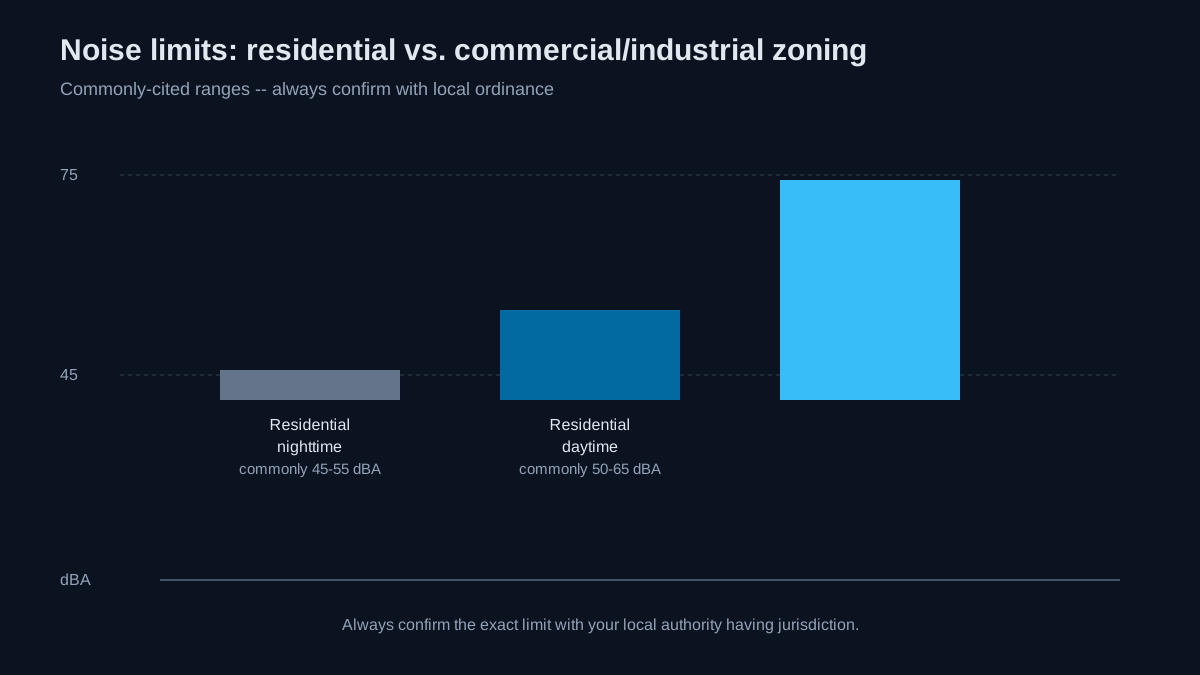
A generator that's perfectly acceptable in a commercial or industrial zone can require significant noise mitigation in a residential one, even at the same electrical rating. Industry sources commonly cite residential noise limits in the 50-to-65 dBA range during daytime hours, dropping to roughly 45-to-55 dBA at night, while commercial and industrial zones commonly permit higher limits, often in the 65-to-75 dBA range -- reflecting the ambient noise profile already present in those zones. Acoustic enclosures can typically reduce radiated noise by roughly 10 to 25 dBA where mitigation is needed, for example near a shared property line or an adjacent residential boundary.
Property-line setback figures are commonly cited in a rough 3-to-10-foot range across jurisdictions, but that figure comes from general industry guidance rather than a commercial-specific standard, and it varies by local code. Generators above a certain kW threshold -- which itself varies by jurisdiction -- typically trigger a formal permit review that includes noise documentation. None of these figures is a fixed rule you can rely on without checking: confirm actual noise limits, setback distances and permit thresholds with your local authority having jurisdiction and your site's own zoning classification, especially if the installation sits near a residential property line.
Straight answers
Is a commercial building's standby generator sized the same way as a telecom or industrial site's?
No. A commercial facility's load is a tiered mix of life-safety, business-critical and secondary circuits plus occasional lift/pump/HVAC-compressor starts -- not a telecom site's rectifier/battery-plus-one-motor profile or a factory's sustained process load. Use the tiered load-shedding approach in this guide rather than a generic per-square-foot estimate.
What is load shedding and why does it matter for sizing?
Load shedding groups circuits into life-safety, business-critical and secondary priority tiers so the generator can be sized for only the loads that must actually run during an outage, rather than the whole building. This typically reduces required capacity, fuel volume, footprint and noise output.
How many hours of runtime does a commercial standby generator need?
Most sets under 1,000 kW ship with a sub-base tank in the 24-to-72-hour range under common NFPA 110/UL 142 class conventions, running at roughly 70-75% load during an actual outage. That manufacturer default is a floor to check, not an automatic answer -- set your actual target from your facility's acceptable outage duration and refueling access.
Should a commercial building use a diesel or natural-gas generator?
Diesel remains the majority choice for commercial and industrial standby power due to faster block-load response, on-site fuel independence, lower cost per kW and service familiarity. Natural gas is a strong option where the building already has a reliable, documented gas supply, offering long-runtime operation without on-site fuel storage. GENKVA builds both configurations across its published capacity range.
Does the ATS need to do more than just transfer power for a commercial building?
Yes. It needs to sequence reconnection across your load tiers (life-safety instantly, business-critical shortly after, secondary staged in), carry the correct amperage rating and application-class listing (NEC 700/701/702, commonly under UL 1008) for whichever tiers are life-safety-adjacent, and match the transfer sequence your controls provider designs around your tier plan.
What noise or permitting rules apply to a commercial-zone generator?
Commercial and industrial zones commonly permit higher noise limits (often cited around 65-75 dBA) than residential zones (often cited around 50-65 dBA daytime, 45-55 dBA nighttime), and acoustic enclosures can typically cut radiated noise by 10-25 dBA. Setback distances and permit thresholds vary by jurisdiction -- confirm with your local authority having jurisdiction rather than assuming a generic figure applies, especially near a residential property line.
Sources and scope
The load-tier, service-level and fuel-type framing in this guide reflects GENKVA's own published commercial standby power guidance. The load-shedding priority-tier framework, runtime/tank-class conventions, diesel-vs-gas industry tradeoff pattern, and noise/zoning figures are drawn from the third-party industry sources listed below; treat all runtime, tank-class, dBA and setback figures here as commonly-cited general industry guidance to verify against your own site's regulatory jurisdiction and load study, not as a GENKVA-specific commitment or a substitute for an engineer's or code official's determination. This guide does not restate the standby/prime/continuous duty definitions or the motor-starting inrush methodology -- it applies both to the commercial-facility load-tier context rather than re-deriving them.
- GENKVA -- Commercial Standby Generator Power application guidance
- Woodstock Power -- What Is Load Management for Generators?
- Power Generation Enterprises -- Standby Diesel Generators: Buyer's Guide
- National Generator Authority -- Generator Noise Regulations
- iblighting.com -- Generator Setback Requirements
Ready to size standby power for your building?
Send GENKVA your essential-circuit tier list, target autonomy, fuel-type preference and any known zoning constraints for a configuration review.
Request a generator quote